What is creating your next genetically superior herd matriarch worth to you? What is it worth to add more value to your next calf crop that steps across the scale on sale day or the last lot of heifers that close out the sale? Some may say it’s priceless, but they all add up to real dollars and cents. But just how many dollars end up in your pocket depends on factors such as genetics, performance, weight and uniformity – all of which can be better achieved through artificial insemination (A.I.).

What is A.I. worth to you?
Long debated has been the cost of commercial beef A.I. and its advantages over natural service (i.e., the bull). When a producer is considering A.I. for the first time, cost is often the biggest barrier. However, the financial advantages of genetic gain and the profit earned on sale day from using a proven sire cannot be ignored.
With access to top-tier genetics, A.I. enhances herd quality, shortens calving seasons and ensures more consistent calf crops. These advantages not only elevate herd performance, but recent cattle sale receipts also show how A.I. can have a direct impact on profitability.
The genetic edge
A.I. enables you to select genetics from proven, high-accuracy sires that offer desirable traits such as calving ease, growth and carcass quality. When you buy a yearling bull to turn out with your heifers, you use expected progeny differences (EPDs), the animal’s own performance data and physical appearance to make your best guess, only to find out down the road that the bull’s calving ease isn’t what you’d hoped, his weaning weight EPD is lower than expected, etc. With A.I., you’re using proven sires, so much of the guesswork is eliminated, allowing for targeted genetic improvements that translate into measurable traits.
The biggest advantage of synchronization and fixed-time A.I. programs is the ability to have more calves born earlier in the calving season. This is a result of breeding females in a tighter and earlier breeding window and increased pregnancy rates through a fixed-time A.I. program. A side benefit is the potential to return anestrous cows to fertile estrus, resulting in improved cow longevity and more pregnancies.
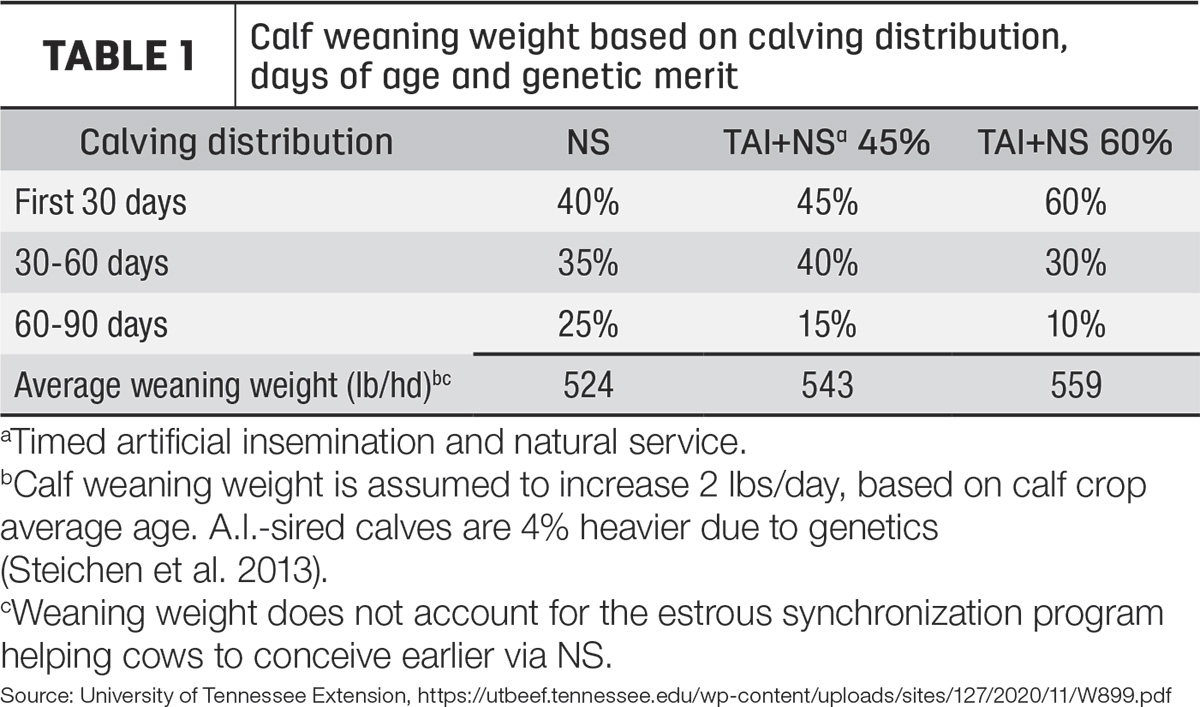
Earlier-born calves from A.I. average 20 to 30 pounds heavier at weaning compared to calves from natural service. Furthermore, using A.I. allows for more calf uniformity; uniform groups of heavier calves drive greater interest from buyers and higher market prices. It’s your opportunity to create genetically superior animals that turn heads on sale day and increase profitability.
Table 1 shows data analyzed by University of Tennessee Extension and indicates the differences between a calf crop resulting from natural service versus the inclusion of a timed-A.I. program. Bigger calves come from the use of A.I. and an earlier calving date, resulting in a higher weaning weight and greater market potential.
Cost analysis
Concerns over cost often deter producers from using A.I. However, the price associated with A.I. is comparable – and often more advantageous – over time. The cost between A.I. and natural service depends on various breeding strategies, synchronization protocols, number of cattle and operational goals. However, the higher return from genetically superior animals, heavier weaning weights and higher profitability in the market through A.I. is indisputable.
Additionally, A.I. reduces risks such as injury, death loss or maintenance costs associated with managing bulls.
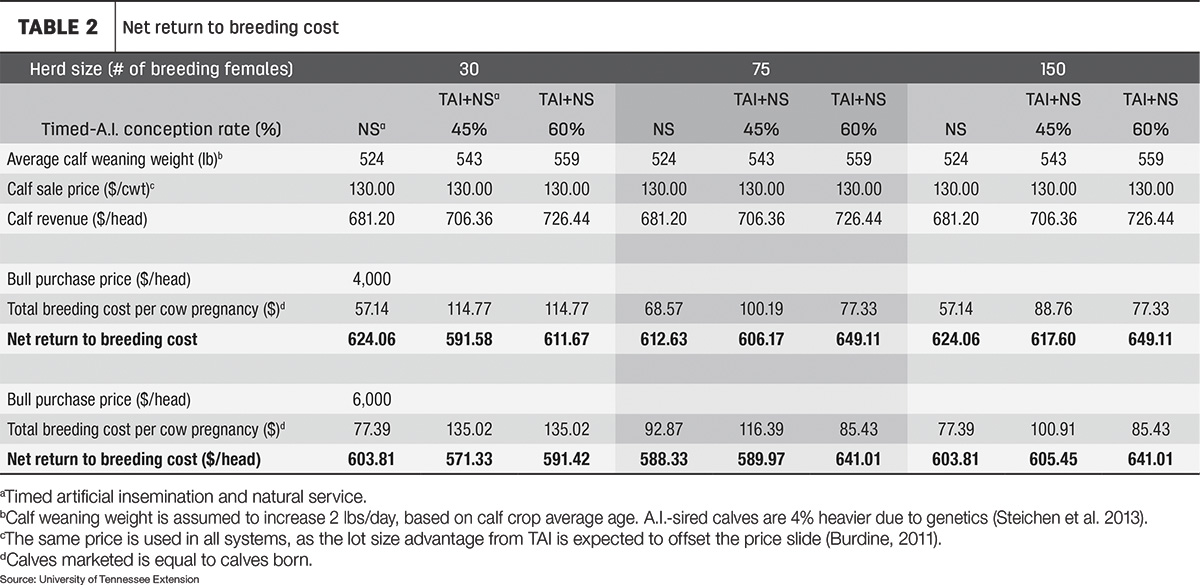
The ultimate goal of the breeding program is to raise as much beef per pregnancy as possible to maximize returns. To do that, we need as many pregnancies as early in the calving season as possible. Table 2, also from University of Tennessee Extension, shows the returns from using either natural service on all of the herd or natural service plus timed A.I. on 45% and 60% of females. Based on herd sizes, the advantages of using a timed-A.I. program is significant.
Market premiums for A.I.-bred heifers
The economic benefits of A.I. extend beyond calf uniformity and genetics; they are also reflected on sale day. At the Little Belt Classic sale in Hobson, Montana, 71 A.I.-bred heifers sold for an average of $3,083, while 70 naturally bred heifers sold for an average of $2,611 – a premium of $472 per head for the A.I.-bred group. At the Arntzen Angus Influenced Commercial Female sale in Lewistown, Montana, 336 A.I.-bred heifers sold for an average of $3,178, while 262 naturally bred heifers sold for an average of $2,720 – a premium of $452 per head for the A.I.-bred group. These substantial differences highlight the market’s preference for heifers bred with superior genetics and your chance for increased profitability.
A.I. delivers tangible advantages, from genetic advancement to higher profitability on sale day. The premium prices of A.I.-bred heifers at recent sales underscore the economic potential that can be gained. By investing in A.I., producers can secure their competitive edge in the industry.
Advantages of A.I.
- Genetic improvements: Access to proven sires guarantees superior traits.
- Higher reliability: The reliability of proven A.I. sires is far superior to that of natural service – particularly natural service with young bulls.
- Increased marketability: A.I.-bred cattle deliver higher sale prices.
- Uniform calf crop: Synchronization leads to a more uniform group, appealing to buyers.
- Shortened calving season: More calves are born early, maximizing growth potential and heavier weaning weights.
- Cost-effectiveness: Comparable costs to natural service with better returns on investment.
- Flexibility: Producers can tailor genetics to meet goals specific to their operation.