If you could pick one word to describe what is going on in the world of agriculture, it would be volatility. With a shorter news cycle, constant availability of new data and, of course, quick policy shifts, volatility has increased exponentially.

We all get that the world of agriculture and commodities is cyclical, but the increased volatility is frankly more challenging to deal with on all fronts than in previous cycles. With that in mind, what are some strategies we should be looking at to manage this increase in volatility?
Stress test your operation
The first thing that comes to everyone’s mind when they think about managing volatility is to dust off their risk management plans. I agree. Understanding the possible range of prices is critical to the discussion, as is understanding your cost of production and your margins.
Ask yourself this simple question: What is the impact to your operation if milk price moves $1 per hundredweight (cwt)? For an operation milking 3,000 cows a day with a 90-pound tank average, the impact is $81,000 – that is impactful. Can milk move $1 per cwt on an export or cold storage report? Absolutely. This is where stress testing is a great tool. That is, run your cash-flow budget at various price levels to understand the impact to your margin. If you do this incrementally, it will help you realize where the loss becomes too big to ignore and may help drive you to pull the trigger on a strategy to make sure you don’t get there.
Stress testing should also include making assumptions on input costs as well. That is, what if interest goes up 2%? What if it drops 3%? Make sure you understand all the tools available to manage your margins. Production management is the thing most producers pride themselves on. Managing margins is what the next-level managers do.
Master your balance sheet
The next step involves examining your balance sheet. Start at the top of both the asset and liability columns – that’s where your working capital is. This is the short-term shock absorber for your operation. That is, the operation’s ability to pay bills and continue operations via cash reserves, line availability and liquidation of short-term assets.
As volatility has increased, I would argue that your working capital reserves also need to be higher. I once thought that having $500 of working capital per cow was a safe number for most operations. Now, I think $1,500 per cow is a much more desirable level. The bottom line with any business is that when you’re out of cash, you’re out of business. Having adequate working capital will help ensure that you do not run out of cash before the cycle rebounds. As a reminder, your risk management plan is a tool to preserve working capital and cash.
Along with price volatility, we’re also dealing with asset value volatility. This can be very impactful to your market-based balance sheet. Over the last several years, we’ve had this feeling that asset values can only go up. Trust me, that is not the case. Just ask any producer, banker or supplier who lived through the 1980s. Machinery values are already under pressure; will land values be next?
The bottom line is that in tough times, you’re reliant on your asset values for borrowing capacity. Be aware of what those values are doing and know what your borrowing capacity is. A tool I like to use is a “discounted core equity calculation” (Table 1). Why discounted? The discount covers the costs of taxes, timing risk and disposition. This is a rough idea of what you would have left after selling.
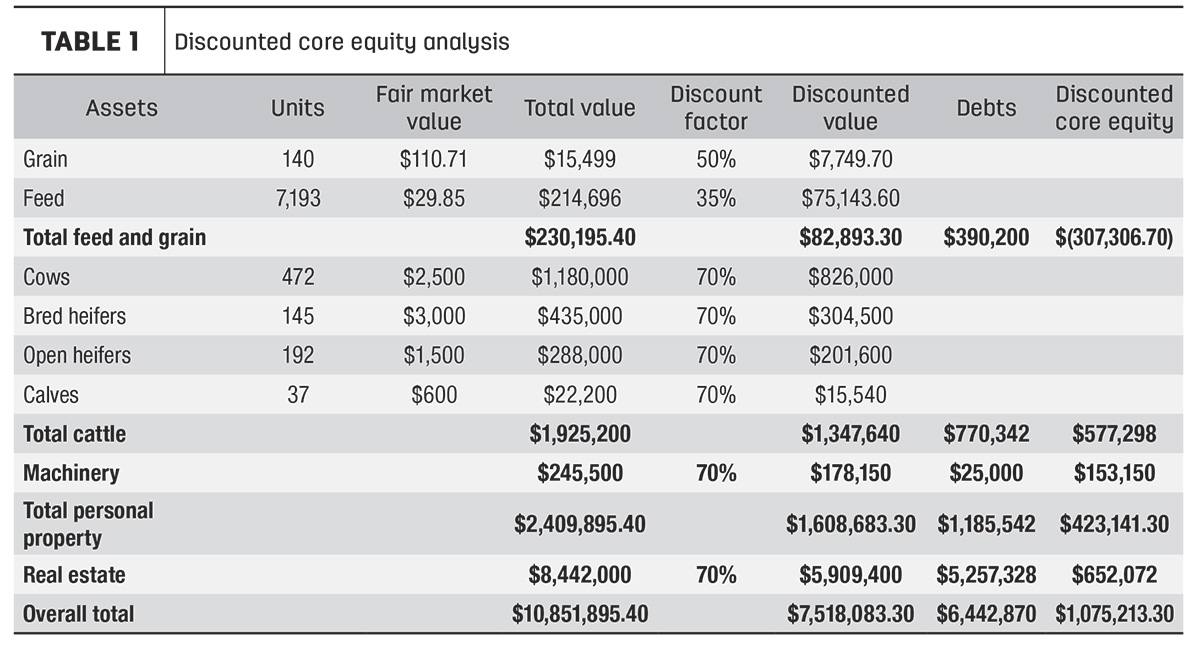
The best risk managers will use core equity in their scenario planning. That is, if milk drops $2 per cwt, how long before you use up that core equity? In the scenario planning process for core equity, asset valuation fluctuation should be a key consideration. In other words, what if asset values drop 30%? Do you still have a cushion in your discounted core equity to manage through the volatility?
I would encourage you to trend this over time for your operation. If you have little or no resilience here, you’ll need a much more robust risk management plan.
Beyond the numbers
Volatility can impact our moods and mental health as well. Be sure you’re taking time to recharge yourself. Whether it’s taking a day off or simply calling a friend, make sure you’re doing self-care. I also encourage you to keep an eye on your neighbors to make sure they’re OK. If you see something, say something.
Yes, volatility is here, and it’s likely here to stay. But there are steps you can take to manage through it. Dust off your risk management plan to preserve working capital and discounted core equity, building a resilient business model for the future.
This article is provided for information purposes only. Readers should consult their own professional advisers for specific advice tailored to their needs. Information contained in this article may be subject to change without notice.