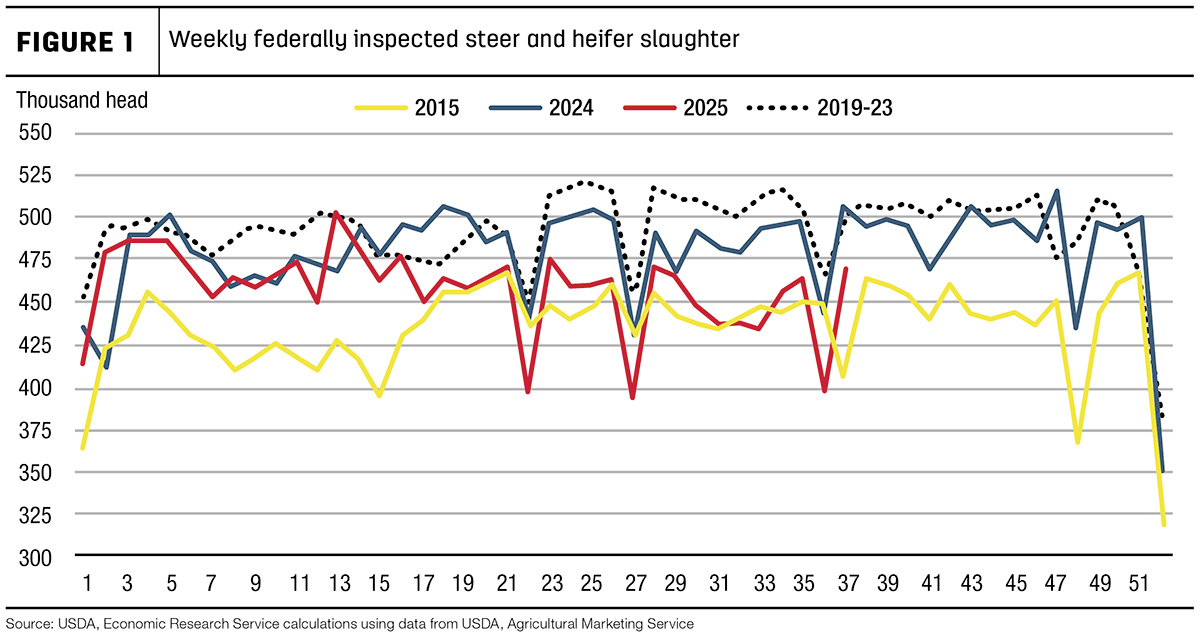
Starting in late July and throughout August, weekly cattle slaughter slowed seasonally but to levels that were the lowest since 2015. Adjusting for one fewer slaughter day in 2025, August saw a 10% decline in cattle slaughter, the largest year-over-year decline for any month in 2025 (Figure 1). Additionally, the number of steers and heifers slaughtered in August fell 4% month over month and 9% from August 2024, adjusted for slaughter days. This slow pace of slaughter is expected to impact the timing of marketings in the second half of the year and into early 2026.
The latest Cattle on Feed report, published by the USDA National Agricultural Statistics Service (NASS), estimated the Aug. 1 inventory in feedlots with more than 1,000-head capacity at 10.922 million head, 1.6% lower than the 11.095 million head in the same month last year. Feedlot net placements in July were 6% lower year over year at 1.547 million head. Marketings in July totaled 1.749 million head, down almost 6% year over year. The year-over-year decline in marketings was largely in line with a 6% decline in federally inspected slaughter of steers and heifers in July.
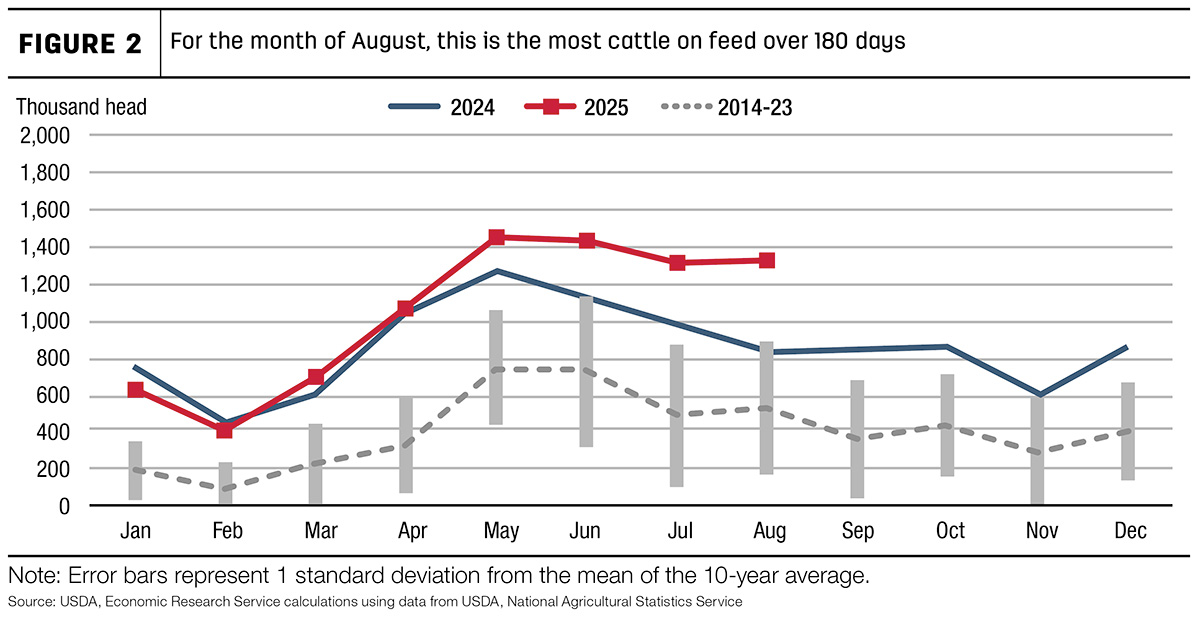
Extrapolated from the five most recent Cattle on Feed reports, the percent of cattle on Aug. 1 that have been on feed over 150 days is the largest since the report was first published in 1996. As shown in Figure 2, further analysis suggests that there are 1.317 million head, or 12% of inventories, that were on feed for at least 180 days on Aug. 1. In terms of total head on feed, this is nearly 60% higher than on Aug. 1 last year and 8% more than in August 2020, the previous high for the month. Texas has the largest number of cattle on feed over 180 days, 15% more than in August 2024. However, Texas has the second-largest share of inventories that have been on feed for more than 180 days, behind Iowa.
The mostly likely reason for steers and heifers in Texas to be spending more time on feed than a year ago is due to the lack of Mexican feeder cattle to backfill pens when cattle are marketed. Feedlot operations prefer to hold cattle on feed longer to heavier weights if cattle supplies are tight in an effort to not underutilize pen space. This trend appears unlikely to change soon, resulting in a relatively slow pace of marketings and carrying a higher share of market-ready steers and heifers on feed through the end of the year.
Based on estimated slaughter data through early September and expectations for marginally lower slaughter in the fourth quarter, the beef production outlook for 2025 is adjusted lower from last month by 100 million pounds to 25.826 billion pounds.
The slower expected pace of marketings in the second half of 2025 is expected to push some fed cattle to be marketed in early 2026. That increase is partially offset by a slower expected pace of slaughter in the second half of 2026. As a result of these partially offsetting trends, the forecast for 2026 beef production is raised 20 million pounds, fractionally higher from last month at 25.49 billion pounds.
Cattle prices set new record highs
The August price for slaughter steers in the 5-area marketing region set a new monthly average record at $243.14 per hundredweight (cwt), which was $6 higher than July and almost $54 above August last year. In early September, weekly cattle and wholesale prices softened from the daily highs set in late August, but remain historically elevated. As a result, the third-quarter price forecast for slaughter steers is raised by $2 to $240 per cwt and the fourth quarter is raised $4 to $244 per cwt. With that price strength being carried into 2026, the forecast for the annual price is raised $5 to $248.50 per cwt.
In August, the weighted-average price for feeder steers weighing 750-800 pounds at the Oklahoma City National Stockyards was $355.55 per cwt, also a new monthly record. This price was an increase of $20.46 from July and more than $121 above last year. In the sale on Sept. 8, feeder steers set a new weekly record of $367.89 per cwt. Accounting for recent price strength, the third-quarter price forecast for feeder steers is raised $10 to $353 per cwt and the fourth quarter is raised $18 to $363 per cwt. This price strength is expected to carry into next year, with the 2026 forecast raised $12 to $362.25 per cwt.
Beef exports
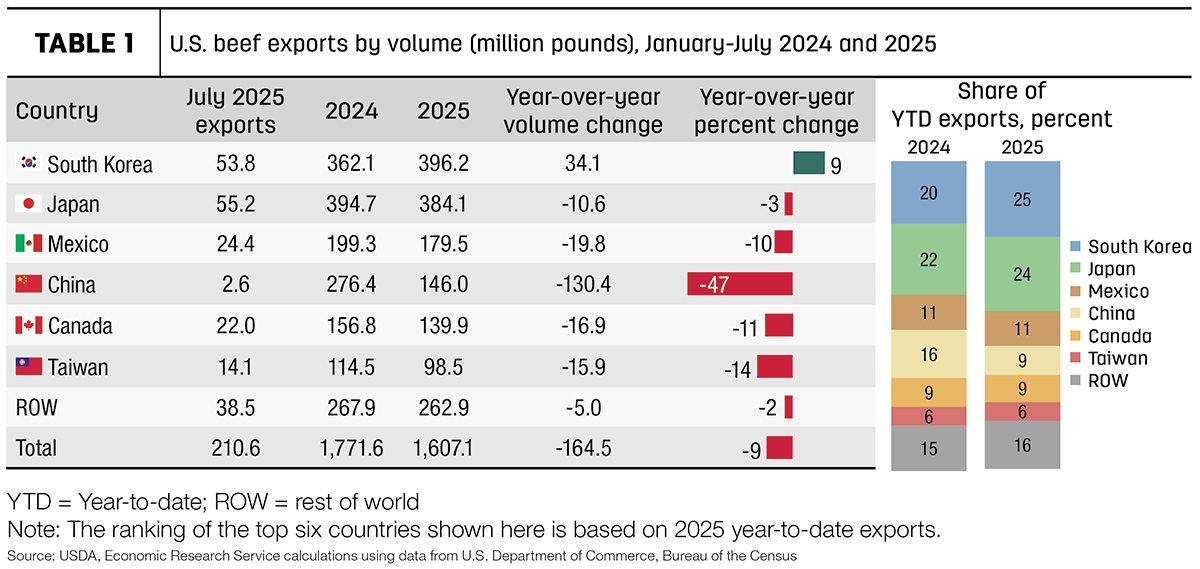
U.S. beef exports in July totaled 211 million pounds, 19% lower than a year ago. Monthly exports to the top six markets were lower year over year except for South Korea, which were up 15% year over year. Exports to China were down 94% while exports to Taiwan were nearly 26% lower year over year. Exports to Mexico were 17% lower than July 2024.
Year-to-date exports are shown in Table 1. Exports to South Korea through July were up 9% compared to the same period last year, but exports to all other major markets were lower. Exports to China were down more than 47%. Year-to-date exports to Mexico were down 10%. Brazil has been shipping more beef to Mexico, with year-to-date exports through August up nearly 200% compared to the same period last year.
The export forecasts for the third and fourth quarters of 2025 are lowered 25 million and 15 million pounds, respectively. The annual forecast for 2025 is now 2.642 billion pounds, which, if realized, would be a year-over-year decrease of 12%. The annual forecast for 2026 is lowered 20 million pounds to 2.525 billion pounds.
Beef imports
Beef imports in June totaled 457 million pounds, about 13% higher year over year (Table 2). Monthly imports from Australia climbed to 119 million pounds, a year-over-year increase of 35%. Australia’s reported exports to the U.S. show continued growth through July, signaling higher imports in the next couple of months once those shipments reach the U.S. Imports from Brazil continued to fall in July to 69 million pounds, about 7% higher than last year (compared to the increases of 89% to 416% over the last four months). The additional tariff on beef imports from Brazil that took effect on Aug. 6 is expected to continue making those imports less competitive in the U.S. market.
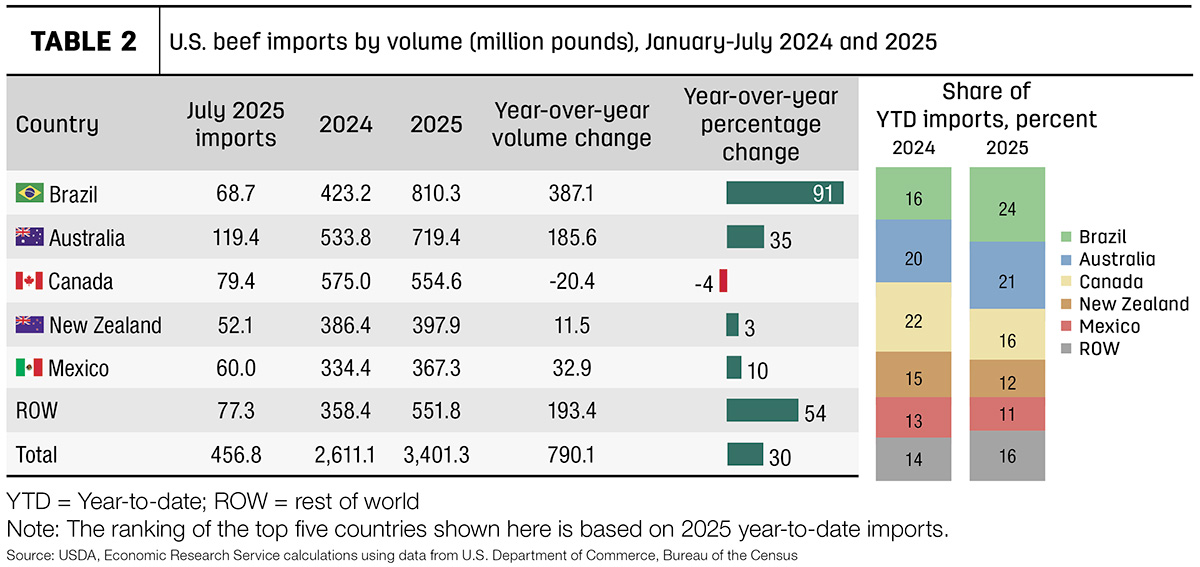
Beef imports from Mexico were up 14% year over year in July. According to the USDA, Agricultural Marketing Service weekly imported meat passed for entry in the U.S. report, weekly imports from Mexico in August were about 14% higher on average than the same period last year. Due to the U.S. ban on live cattle imports from Mexico related to New World screwworm, Mexico has more cattle to slaughter this year. Additionally, Mexico has been importing more beef from Brazil and therefore should have more domestically produced beef available for export. Consequently, the U.S. could continue seeing growth in beef imports from Mexico.
Based on higher expected imports from Australia and other beef exporters offsetting lower imports from Brazil, the forecasts for the third and fourth quarters of 2025 are raised 70 million and 20 million pounds, respectively. The annual 2025 forecast is 5.364 billion pounds, about 16% higher than 2024. The annual 2026 forecast is unchanged from last month at 4.95 billion pounds.