This month’s outlook for 2026 beef production is down 110 million pounds from last month to 25.81 billion pounds. This is the result of a slower than previously anticipated pace of cattle slaughter in February and early March that is partially offset by heavier than previously expected carcass weights. The projection remains about 1% below 2025 levels and 9% below the record high set in 2022.
Drilling down to quarterly changes, first-quarter beef production is lowered by 165 million pounds from last month on a slower pace of fed cattle and cow slaughter, which is partially offset by heavier-than-expected carcass weights. Based on slaughter data from the USDA Agricultural Marketing Service, the February pace of fed cattle slaughter was the slowest for the month since 2016. Conversely, carcass weights were record high for the month of February, with weekly carcass weights averaging 21 pounds more than last year. Further, weekly steer and heifer carcass weights were up 34 and 22 pounds, respectively, throughout February.
In the second quarter, beef production is raised by 45 million pounds from last month on heavier projected carcass weights and higher cattle slaughter that reflects a temporal shift in cattle slaughter out of the first quarter and into the second. In the third quarter, production is forecast higher by 10 million pounds from last month, as heavier carcass weights are carried forward.
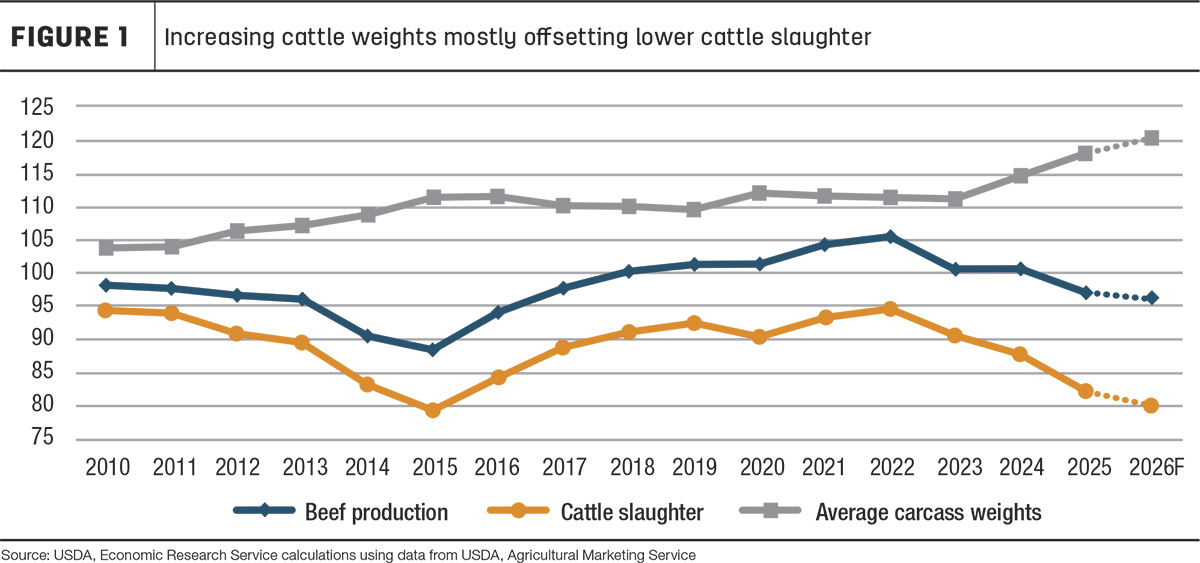
To further illustrate the role of carcass weights on the availability of beef in the market in 2026, Figure 1 indexes the change in cattle slaughter, carcass weights and beef production based on data collected since 2000. Since 2023, large increases in average carcass weights have helped offset fewer cattle slaughtered.
On Feb. 1, the number of cattle on feed over 150 days was up 22% from year-ago levels. Based on weekly slaughter data through early March, the current slow pace of fed cattle slaughter will likely increase market-ready supplies in feedlots and maintain heavy cattle weights. This increase of market-ready supplies of fed cattle is likely supported in part by packers reducing slaughter schedules in February to improve operational efficiencies on a per-head basis, as packer margins are under pressure from paying much higher prices for fed cattle. These measures are keeping cattle in feedlots beyond 180 or even 200 days, supporting heavier carcass weights for fed cattle and partially offsetting lower expected slaughter numbers this year.
The latest Cattle on Feed report, published by the USDA National Agricultural Statistics Service (NASS), showed a Feb. 1 feedlot inventory of 11.505 million head, 2% below the 11.716 million head in the same month last year. Feedlot net placements in January were 5% lower year over year at 1.681 million head. Marketings in January were 1.626 million head, 13% below last year.
Supportive outlook for cattle prices
The fundamentals surrounding cattle supplies still give support to cattle prices despite volatility in the futures market. Further, U.S. feeders and stocker operations continue to buoy feeder cattle prices as they try to secure their needs. In February, the weighted-average price for feeder steers weighing 750-800 pounds at the Oklahoma City National Stockyards was $371.42 per hundredweight (cwt) – $101 above the prior year and the second-highest monthly average price on record. In the first two weeks of March, prices cooled off to an average of $365.89 per cwt. Based on recent price strength and continued firm demand for feeder steers, the 2026 price forecast is raised $3 from last month to $367.25 per cwt.
For the week ending Feb. 22, slaughter steers in the 5-area marketing region posted an all-time record-high price of $246.91. The average price in February was $244.23 per cwt, nearly $10 above January and nearly $42 above last year. However, as packer margins continue to be under pressure, slaughter cattle prices slipped $7 to $239.94 per cwt in the first week of March. Based on recent price data, price forecasts are raised $2-$3 in the first three quarters. As a result, the 2026 annual slaughter steer price is raised to $242 per cwt, an 8% increase from last year.
Potential strike at large beef slaughter plant
On March 6, workers at the JBS beef plant in Greeley, Colorado, gave notice to management that they planned to strike at midnight March 15. In anticipation of the walkout, industry analysts have noted that JBS was halting slaughter starting March 9 to finish processing remaining carcasses. It is estimated that JBS harvests 5,000-6,000 head per day at their Greeley plant. While lower slaughter levels for the week starting March 9 were considered in the USDA’s forecast, the potential for the strike starting a week later was not. In the media, JBS spokespeople noted that it would “temporarily shift production to other JBS facilities, where we currently have excess processing capacity.”
Beef exports
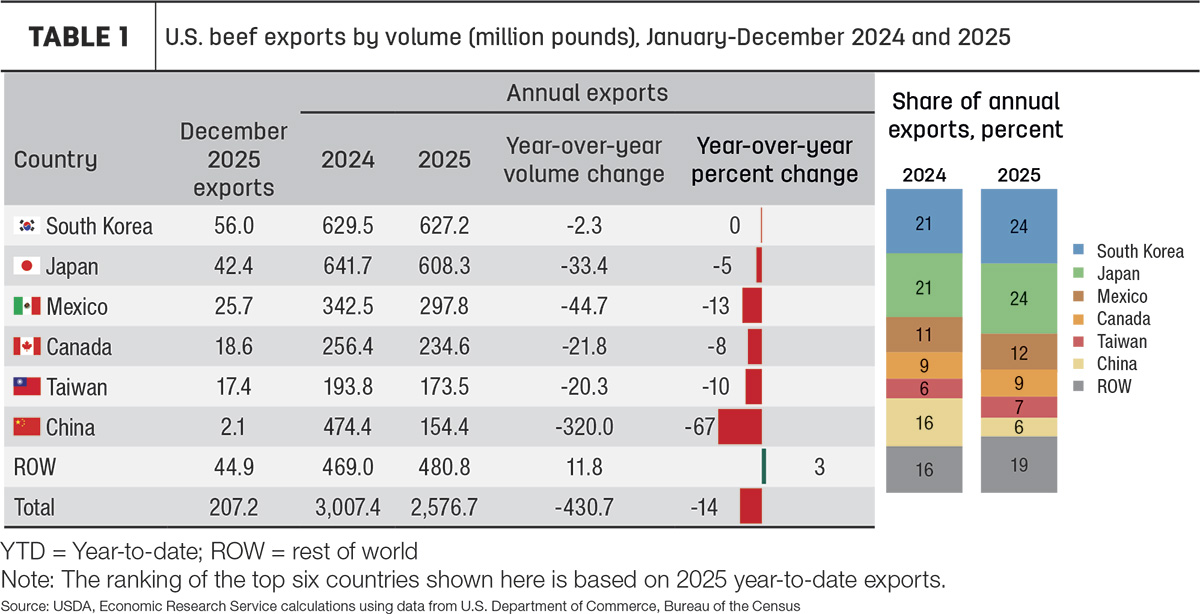
The latest U.S. trade data available as of the March World Agricultural Supply and Demand Estimates (WASDE) report publication was through December 2025. Beef exports totaled 207 million pounds in December, 20% lower year over year. Annual exports totaled 2.577 billion pounds, a 14% decrease year over year. Table 1 shows the annual exports to the top six markets and the share of exports to each market. The decrease in exports to China accounted for more than 74% of the total year-over-year decrease in U.S. exports. Exports to all the top six markets were lower year over year, but exports to all other markets combined were about 3% higher year over year.
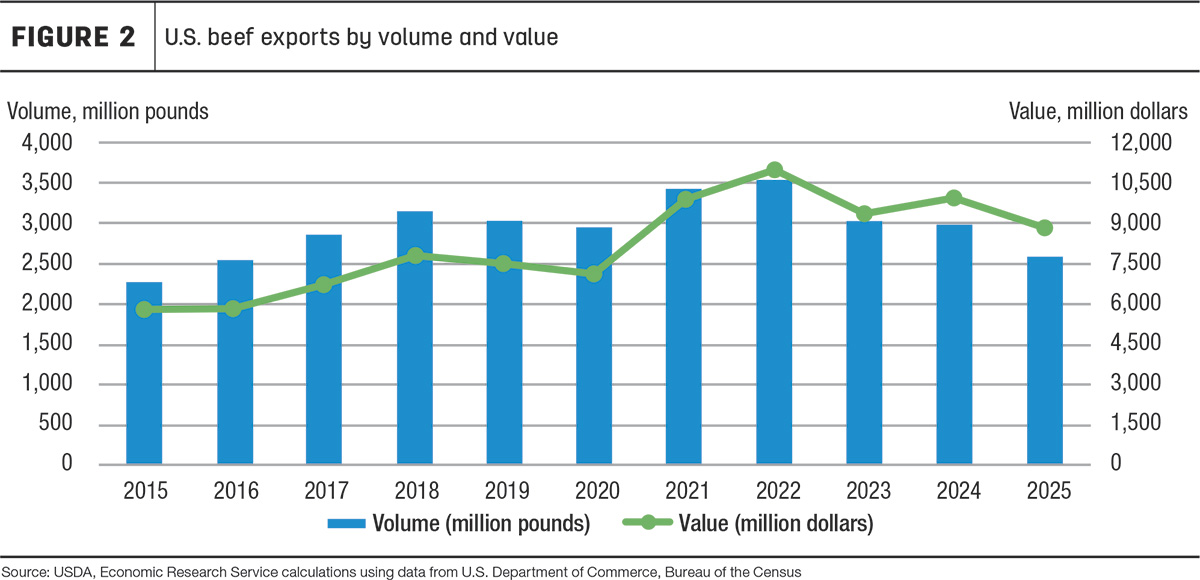
The total value of beef exports in 2025 was $8.8 billion, a year-over-year decline of 11%. Figure 2 shows the volume and value of U.S. beef exports since 2015. While the volume of beef exports has declined over 27% since the peak in 2022, the value has declined 19% over that time as stronger beef prices partially offset the decline in volume. Continued strong beef prices are expected in 2026, limiting the competitiveness of U.S. beef on the global market.
Based on the slower pace of exports in December and reduced domestic beef production leading to tighter exportable supplies, the export forecast for the first quarter is lowered 20 million pounds to 610 million pounds, and the second-quarter forecast is lowered 10 million pounds to 630 million. The 2026 annual forecast is 2.395 billion pounds, which would be a year-over-year decrease of 7%.
Beef imports
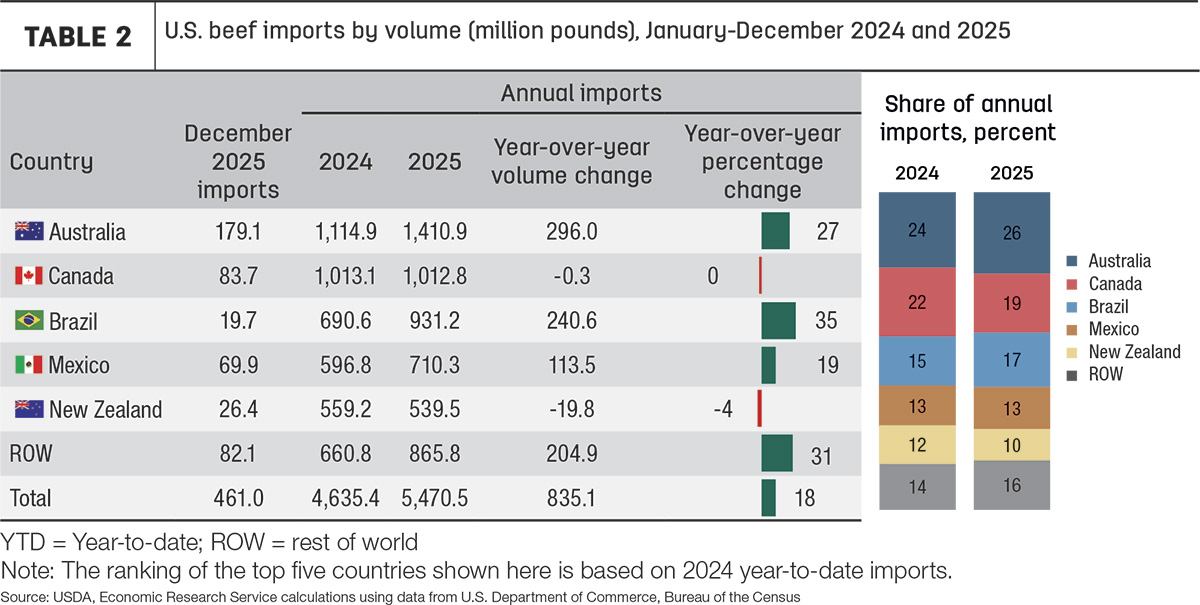
Beef imports in December were 461 million pounds, rounding out the year at a record 5.471 billion pounds. Table 2 shows annual imports from the top five suppliers and the share of imports from each country. Australia was once again the largest supplier of beef imports to the U.S., with a 27% year-over-year increase. Imports from Canada – the second-largest supplier – were nearly unchanged for the year. Imports from Brazil were up 35%, increasing its share of U.S. imports to 17%. Imports from countries not in the top five were also significantly higher, up more than 200 million pounds (31%) from 2024.
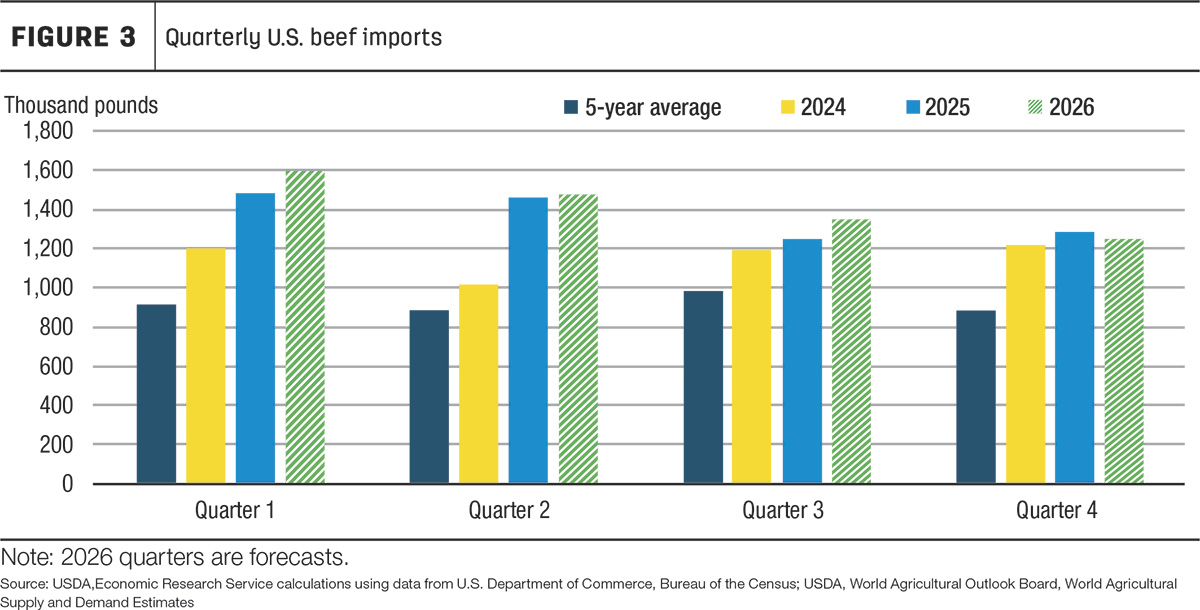
The majority of the year-over-year increase in imports in 2025 occurred in the first two quarters. Figure 3 shows U.S. beef imports by quarter, including the forecasts for 2026. First-quarter imports continue to grow due to the influx of imports in January as importers take advantage of the open tariff-rate quotas. The seasonal pattern of higher imports in the first half of the year is expected to continue in 2026. Based on continued strong demand for imported lean trimmings, the import forecast for the first quarter is raised 50 million pounds to 1.6 billion. The forecasts for the third and fourth quarters are also increased 25 million pounds each. The annual forecast for 2026 is 5.675 billion pounds, almost 4% higher year over year.