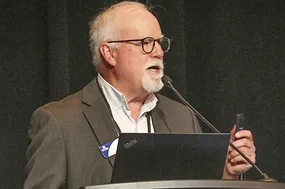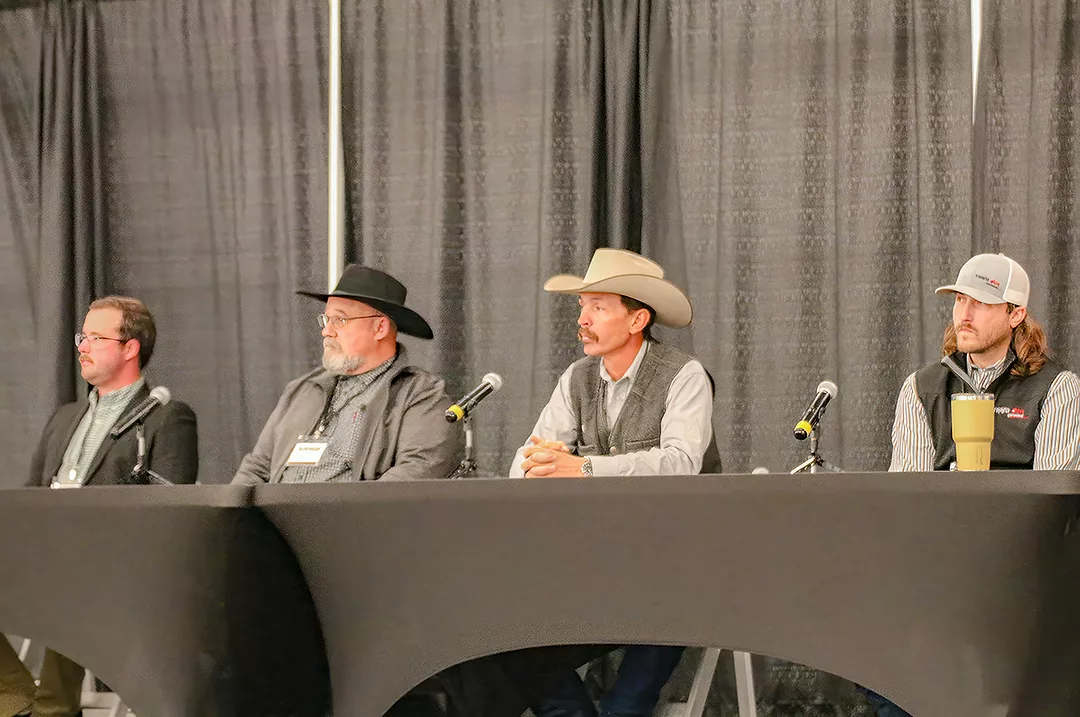
At the 2025 Range Beef Cow Symposium, held in Cheyenne, Wyoming, Jay Parsons with the University of Nebraska – Lincoln (UNL) facilitated a panel discussion focused on rebuilding the cow herd. The panel included Connor Biehler, UNL extension educator and coordinator of the Great Plains Heifer Development Program; JD Hill, a rancher who runs a large organic grassfed herd based in northern Wyoming and southern Montana; James Sewell, a first-generation Wyoming rancher with a cow-calf herd and stocker operation; and Kiernan Brandt, professional service technician for Trans Ova Genetics, also involved with the Great Plains Heifer Development Program.
If a producer in their 30s wanted to start expanding their herd, what is the number one thing you’d tell them to make sure they get right?
BIEHLER: I think you want to make sure that you're purchasing the right genetics that meet your marketing goals as well as something that fits your environment. And also using bulls that fit your environment. At the Heifer Development Center, one thing we really like to do on heifers is use proven high-accuracy bulls once it comes time to breed them, and we have a specific culling protocol for replacement heifers.
BRANDT: In reference to what Connor was mentioning, we've embraced a three-strike policy: first, identifying the percentage, whether that's the bottom third, or the bottom 25% of your heifers with the smallest pelvises; second, setting them up in a position where you can identify which of those animals don't get bred during the first round of A.I.; then the third strike would be any calving difficulties during that first calving event.
HILL: Evaluate if you really have the room to grow in your operation. I don't know how it is out in all you folks’ country, but leases are hard to come by. Where we're at, we run on a lot of deeded ground, and we also run on a lot of leased ground, so that's one of the first things that we're looking at is: Is there that opportunity for growth?
From the perspective of rebuilding the herd, what is the primary risk you would want to address?
SEWELL: If I was keeping heifers, or thinking about keeping heifers, I would have an exit strategy within two years at most. I would not think about getting paid off in seven calves, that is just not going to happen. You'll be very disappointed, I think, historically, at the top of the cycle keeping anything, but if you have a fairly quick couple-year exit strategy, you might be less disappointed with whatever you decide to keep, as far as selling animals.
What are your exit strategies?
BRANDT: I am a 30-year-old young producer, and frankly, it's terrifying. I'm not going to lie to you guys, it's nerve wracking. A big part of it is the volatility and not knowing what’s going to happen and just trying not to get so starstruck with high sale averages and big price tags at the sale barn. It's important to keep it realistic. I think it also depends on where you're at and who you have in your corner, and who you have on your management team that's helping you make these decisions.
HILL: In my mind, it's all about cost management. One of the biggest drivers for growth is dilution of your overhead costs. Even though we're seeing these record prices, our margins, I wouldn't say this year but over the last three or four years, have actually been smaller than they were the last time they saw one of these big run-ups. So I think the big thing is, don't be going and getting giddy about this thing just because of where you see these current price structures.
BIEHLER: One of the most important things that I would hone in on is the cost of development. We're not getting more pastures. Unfortunately, where we used to see corn, we now see a lot of five-strand barbed wire fence with roads through it. I know there's data out there that suggests that developing heifers isn't maybe going to be the best for longevity right now, so that's something to take into consideration. But also, what are your costs, and how can you do it effectively and do it without cutting corners? I think the most important thing is trying to do it inexpensively, not cheap.
What is going to be the effect of beef-on-dairy?
BRANDT: I maybe have not always been the most outright advocate of beef-on-dairy, but I will say that a sustainably sourced, domestic, high-quality beef supply is never going to be a bad thing in my mind. And there's nothing wrong with the guys on the dairy side trying to capitalize on the success we're seeing on the other side of things. It's here to stay as long as I can see.
What’s an effective strategy for marketing animals that didn't fit your program so you can capitalize on what you already have?
HILL: We rebreed a lot of our cull cows if they don't fit our system, for whatever reason. We’re always looking for opportunities to add value to a cull cow. One of our biggest strategies is to always look to try to add value to a cull cow if you have the ability and feed resources to be able to do that.