Over the last decade, I have watched Holsteins transform right in front of us, and honestly, it is one of the most underrated success stories in livestock genetics. You do not need charts or genomic trend lines to see it – just look at the bulk tank. The modern Holstein is a component machine, and nowhere is that more obvious than in the dramatic rise of butterfat and fat percentage. I remember when 3.6% fat was seen as pretty good. Today, in well-managed herds, 4.2%-4.5% is not boastworthy anymore – it is expected. That kind of progress does not happen by accident; it is the combined force of genomics, index-driven selection and breeders who started giving fat the respect the market was begging for.

Selecting for fat
Of course, one of the classic players in this story is diacylglycerol O-acyltransferase 1 (DGAT1), the gene that has been influencing fat synthesis longer than we have been measuring it. Not every Holstein breeder talks about DGAT1, but its alleles have been quietly shaping the breed’s fat trajectory for years, especially once genomic tools allowed us to track it more effectively. Sires carrying the favorable variant have consistently lifted fat yield without blowing apart production or fitness traits. When I talk to producers today about why their fat percentage looks so different from 10 years ago, DGAT1 usually is not the first thing on their minds – but it is sitting there in the background, like a veteran role player on a championship team.
Most dairy producers notice the outcomes in their fat percentage bulk tank readings long before they ever hear the words “K allele” or “A allele,” but those two variants have been quietly shaping how the Holstein breed deposits energy for decades. Table 1 shows what each allele tends to.
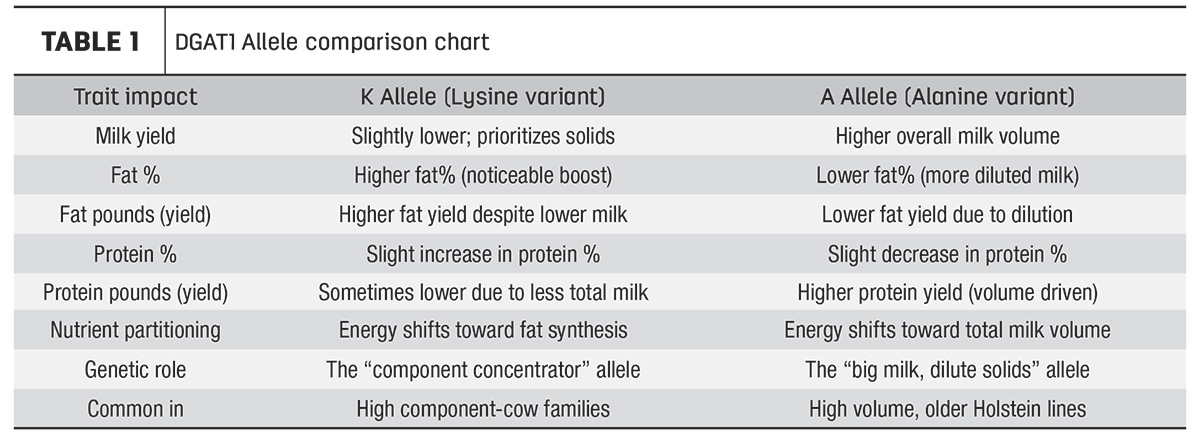
What is fascinating is how these alleles map directly onto the economic story of the last 15 years. As butterfat became more valuable, we naturally selected toward bulls and cow families that favored the K allele pattern – not because we were explicitly selecting for DGAT1 but because we were selecting the phenotype it produces. Genomics simply made it easier for breeders to double down on the right cattle and accelerate the trend. In many herds, you can literally watch the allele frequencies shifting generation to generation based on how fast fat percent has risen, while continuing selection pressures on other genetic regions contributing to volume.
Protein on the rise
While Holsteins have been stacking fat at a stunning pace, you can feel the momentum shifting toward protein. The economic forces are pushing us there: Processors want more protein for cheese yield, consumers want more protein in everything from high-end yogurts to grab-and-go sports drinks, and milk pricing is rapidly nudging protein into a more valuable position. Processors are also noticing the big gains in Holstein fat percent and are struggling with the protein-to-fat ratio at the plant. They need higher protein content for cheese, yes, but they also need a favorable ratio of 0.8 to 0.85 before vatting, and some markets require greater than 0.9. They adjust this by either adding protein or removing fat.
If fat was the big genetic win of the last decade, protein is the next frontier staring at us right in the face. The encouraging part is that the building blocks for a protein surge are already here – we are seeing more bulls transmit 50-70 pounds more protein, and herds using genomic testing aggressively are identifying high-protein youngstock and utilizing mating programs to maximize protein volume and percent. We also continue research into genomic tools for selection in protein percent. We know the B variant of kappa casein influences protein percent along with curding in cheesemaking. Genes like beta-lactoglobulin, apolipoprotein M (APOM) and cytochrome P450 family 7 subfamily A member 1 (CYP7A1), along with breeder selection pressure for protein percent and volume, will allow us to make strides in this next frontier.
The influence of genomics
That is another big turning point in the story: the rise of genomic testing. At this point, if you are not genomically testing heifers, you are basically trying to compete in the modern dairy business with yesterday’s information. Genomic testing is the tool that has allowed us to push components higher without guessing, without waiting and without accidentally steering the herd backward on volume. When I walk into herds that have been testing heifers for five, six or seven years, their young cows do not just milk better, they milk the right kind of milk: high-component, high-value milk. Plus, they do it earlier in life because selection pressure has been laser focused. Genomics is the reason we know which heifers carry elite protein percent potential; the reason we can intentionally breed for components, milk volume and health in combination; and the reason the next wave of progress is coming faster than the last one.
The role of beef-on-dairy calves
On top of this, beef-on-dairy has completely changed the calculus of genetic strategy. We are no longer trying to get replacement heifers from every cow; we can be choosy, really choosy. The top 40%-50% of the herd identified through genomic testing can drive the next generation of milk, components and efficiency. The bottom end of the herd? They are carbon-friendly, feed-efficient beef calves that fit beautifully into today’s supply chain. This shift lets us double down even harder on the traits that matter in the Holstein population without getting buried and financially burdened in extra heifers we do not need. It is one of the hidden forces accelerating component gains – and it is only going to amplify protein progress as producers target the very best animals for replacements.
The future
When I look at where Holstein genetics are headed, the pattern is obvious. We mastered fat. We changed the narrative about Holsteins being low- component cows. We did it with intention, science and better tools. Protein is next. The economic indicators are lining up. Consumer demand is unmistakable. The genetics – from DGAT1 selection to genomically identified, efficient protein stars – are sitting there ready for us to take advantage of them.
The future Holstein is not a big cow, a typey cow or a fashion show cow. She is a solids cow – a sustainable, efficient, high-component producer built for the real modern dairy economy. As fat plateaus at these impressive new highs, protein is getting ready to take its turn in the spotlight. We are not just breeding for milk anymore; we’re breeding for markets. Markets are saying loudly and clearly: Bring on the protein.