Processing was addressed by those surveyed for State of Dairy as both an exciting opportunity and a challenge in some regions – especially since there are still many unanswered questions about how it will ultimately affect milk flows, if new processing facilities will eventually lead to the closure of some other existing ones and how much new capacity is actually available.

Unsurprisingly and unfortunately, a variety of regulations continue to challenge West Coast farms, creating a tough business climate for agriculture. One proposed measure in Oregon would make artificial insemination of animals – among other things – illegal in the state if it passes.
As outbreaks of New World screwworm (NWS) get closer to the U.S. border, Texans are closely watching the situation, hoping it does not become the latest disease outbreak.
New processing capacity has some dairies in growth mode
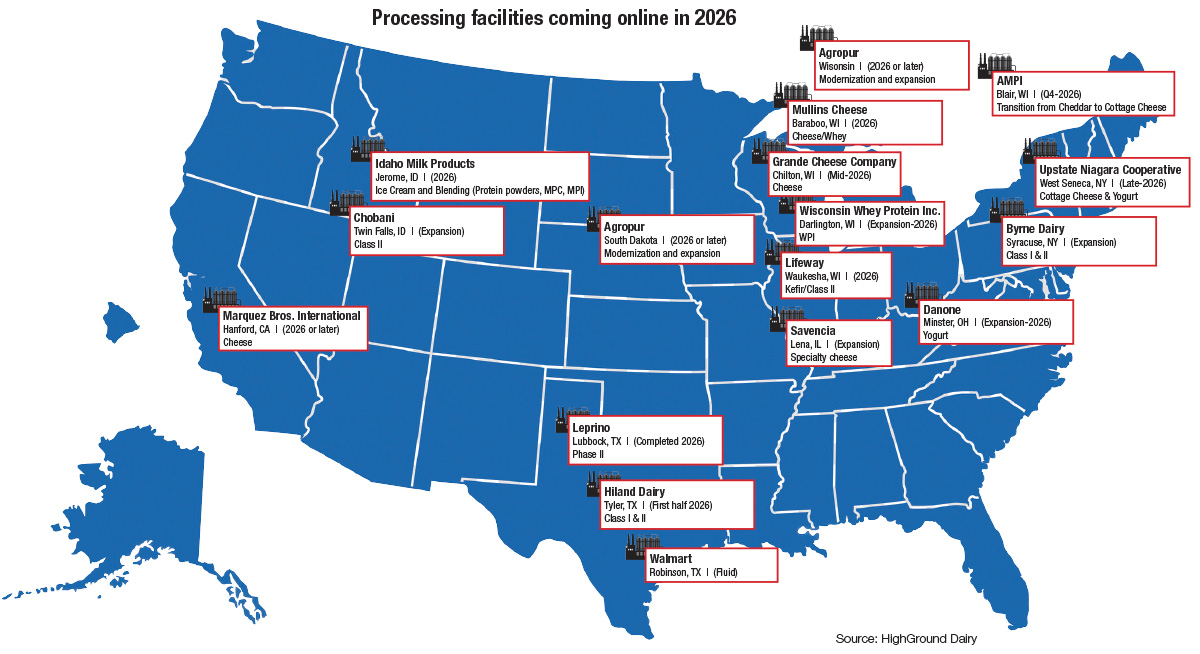
According to HighGround Dairy, at least 15 new or expanded processing facilities are scheduled to open in 2026 (see map). However, many in the dairy community are still unsure about the long-term impact on milk flows and overall capacity.
“Even before all of the capacity is fully online, it’s already influencing conversations,” says Travis Senn, assistant director of milk marketing and analytics, Southeast Milk Inc. “The opening of Walmart’s new processing facility [in Georgia] has producers and industry partners thinking more carefully about milk movement, hauling distances and long-term market access. New capacity always brings both opportunity and uncertainty. What’s important is that producers aren’t ignoring those questions. They’re asking how changes in processing will affect pricing, logistics and labor needs. Those conversations are happening early, which is critical during a period of transition.”
He adds that new processing investments in the Southeast are signaling confidence in dairy production in the region.
“Producers recognize that capital investment like this doesn’t happen without a belief in the future – even if the path forward includes some near-term uncertainty,” Senn says.
New processing facilities and a mild winter have dairy producers in Texas poised to grow milk production this year.
“If spring rains come, then Texas definitely should have a productive year,” says Darren Turley, executive director, Texas Association of Dairymen. “Texas is in the midst of a boom of new plant capacity coming online. Leprino’s cheese plant in Lubbock opened in 2025, and the Walmart fluid milk plant will open in central Texas near Waco this spring. Having a new customer in the region gives our dairy farmers optimism in the market. By the fall, producers will start to see the changes that this new plant capacity brings to the market.”
The increased processing capacity nationwide has resulted in more cheese.
“Throughout 2025, the dairy industry did an excellent job moving the additional cheese via increased exports, but when the EU production increased, they also lowered their prices to compete with the U.S. and win some share of business. So we arrive at our current terrible prices; more cheese means more competition. I hope we can win back some of that business soon,” says Anja Raudabaugh, CEO of Western United Dairies in California.
In the Northeast, many of the base excess programs that were in place in recent years have been eliminated or have become less strict, providing opportunities for growth for those prepared to capitalize on that opportunity, says Jayne Sebright, executive director at the Center for Dairy Excellence in Pennsylvania.
Jon Hermonot from Fairholm Farm in Connecticut is optimistic about the large processing investment coming online in New York.
“It allows for more efficient and flexible milk supply balancing with new plants that have large milk-holding capacity,” he says. “The increased processing capacity in the Northeast hasn’t affected our farm, but our milk cooperative has benefited from increased contracts in the region and has allowed farms to grow to help meet demand.”
Dairies in Idaho are also in growth mode.
“There are expansions occurring in both processing and dairy production,” says Rick Naerebout, CEO at Idaho Dairymen’s Association. “We are still a growth industry in Idaho, and that brings with it a lot of momentum and positivity. We have seen base programs implemented for several years, and to have these growth opportunities at a rate better than 1 percent (2020-24 average production growth in Idaho) are significant.”
Naerebout says the overall sentiment among the dairy community in Idaho is bullish, despite lower milk price forecasts for 2026.
“No one is looking forward to milk prices this year, but most operations are coming into 2026 after two solid years of financial performance,” he says. “Idaho’s increase of 7.5 percent year-over-year milk production underscores this fact. Despite milk prices tailing off at the end of 2025 and into 2026, we have had a lot of growth, and I think the growth sticks with producers more than the ebbs and flows of milk prices when they look back on it.”
The positivity is high in Nebraska, as state dairy leaders actively promote their area to dairies looking for a new place to call home.
“Nebraska has historically been a small dairy state but has started to see an increase in production and processing,” says Kris Bousquet, executive director, Nebraska State Dairy Association. “I think more people are recognizing that the I-29 corridor is maturing, and other larger dairy areas are seeing difficulties with water quantity and availability and manure/waste management. One of the last spots where large-scale growth is possible is Nebraska. You can consider this beef state as the next dairy frontier for a lot of valid reasons.”
One of those reasons includes the multiple processing and dairy facilities that have already or are currently expanding or building greenfield facilities.
“One processor is expanding into caseinates and proteins, and we have a new greenfield dairy [plant] that is under construction and will be doing aseptic bottling,” Bousquet says. “The shift in production is going to create opportunities for new dairies to be built as well as for existing producers to expand. There are producers who have started the expansion process or that will start this spring."
Regulatory challenges in the West
Regulations and a business environment that is not very agriculture-friendly continue to plague dairy producers in Washington, Oregon and California.
“One of the most challenging aspects of dairying right now is navigating the increasing number of regulations that affect how we operate,” says Anthony Agueda from Alberto Dairy in California. “It means spending more time and resources on compliance, paperwork and planning, which can take focus away from the day-to-day management of the dairy. Finding ways to meet regulatory expectations while remaining economically viable continues to be a major challenge.”
State regulations continue to make operating a dairy farm difficult in Washington.
“Some of the biggest challenges are coming out of our state capitol in Olympia,” says Dan DeRuyter from George DeRuyter and Sons Dairy in Washington. “We are facing new regulations, and taxes are going to be a challenge going forward. Specifically proposed payroll taxes, minimum wage increases in Washington state, regulations like heat abatement and smoke regulations, environmental regulations and citizen lawsuits – to name a few.”
In Oregon, regulations are some of the greatest threats to dairy farming right now.
“We expect IP 28 to be on the November ballot,” says Tami Kerr, executive director, Oregon Dairy Farmers Association. “If passed, it would make hunting, fishing, rodent control and processing of animals for meat illegal. Breeding animals artificially would be a sexual assault. It’s extreme on every level. With Oregon’s high environmental standards and worker protections, we should produce food in Oregon. It will take a lot of time and money to educate voters and defeat the measure.”
Additionally, water regulations, required water supply plans for all licensed dairy farms and a proposed ag labor standards board are among other concerns, along with the NPDES CAFO permit being renewed. Kerr says there are many questions about how producers will be impacted when final rules are released.
Agriculture overtime laws have been in effect for several years in the three West Coast states, and many of those states are also facing minimum wage increases, despite already having some of the highest minimum wage rates in the country.
“In addition to that, meal and rest period compliance also increases labor costs significantly,” Agueda says. “Dairies are also subject to expanded reporting and documentation requirements tied to environmental compliance, manure management and nutrient application."
NWS in Texas
The Texas dairy industry is poised for a challenging 2026 with low milk prices and a potential outbreak of NWS, Turley says. At the time this article was written, the northernmost active case of NWS is about 200 miles south of the Texas/Mexico border.
“Hands down, the threat of New World screwworm is a dark cloud over the Texas dairy industry that is also affecting other livestock industries,” Turley says. “It appears to be drawing closer to the Texas-Mexico border, and it is likely we will see it cross into Texas this spring or summer. I hope I’m wrong. Even though an infestation would be much more devastating to ranchers and wildlife than to dairy farms, it will be destructive to many farms, markets and industries in Texas. The possible stop movement of cattle alone can wreck markets. Should it cross into Texas, it would be a serious threat to the health of livestock and livelihoods of dairy farmers in Texas, the nation’s third-largest milk-producing state.”
Due to the resurgence of NWS in May 2025, the USDA suspended imports of live cattle, horses and bison from Mexico through southern border ports. NWS is a parasitic fly that poses a significant threat to livestock and wildlife.
The pest, known for causing myiasis by infesting living tissue, was previously eradicated from the U.S. in the 1980s after 30 years and extensive efforts.
In a move to safeguard U.S. livestock and ranching operations from the threat of NWS, the USDA on Jan. 21 announced the launch of the NWS Grand Challenge, a major funding initiative designed to accelerate innovative tools, technologies and strategies to combat the northward spread of NWS.
On Jan. 29, Texas Gov. Greg Abbott issued a statewide disaster declaration to prevent NWS fly infestation and to protect livestock and wildlife. Abbott’s preemptive actions include:
- Directing the Texas Parks and Wildlife Department and the Texas Animal Health Commission to establish a joint NWS response team
- Partnering with the USDA to create a new $750 million domestic sterile NWS production facility in Edinburg, Texas.