As we progress into 2026, high-oleic soybeans continue to be a major topic of discussion at dairy producer meetings and in published articles. At a recent farm team meeting, a financial adviser commented that they’ve seen only a few technologies that can drastically reduce cost of production: the implementation of a total mixed ration (TMR) mixer, recombinant bovine somatotropin (rBST) and now, perhaps, high-oleic soybeans will join the list.

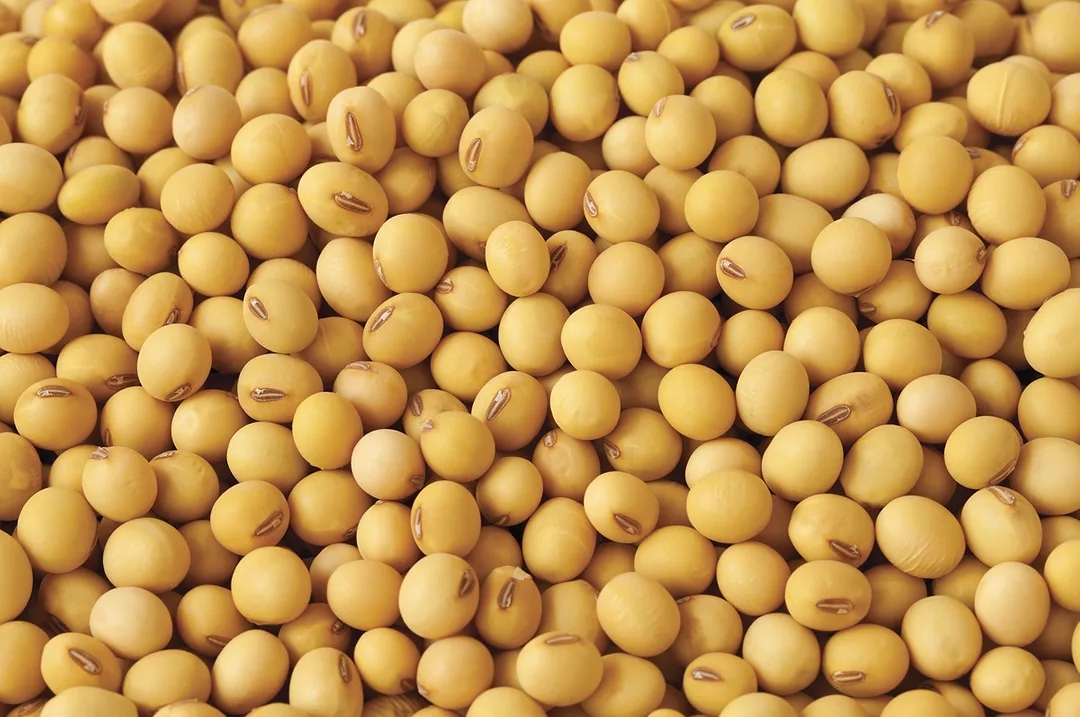
In the past, nutritionists were limited to feeding 2 to 3 pounds of conventional soybeans to limit the risk of milkfat depression. While conventional soybeans and high-oleic soybeans have similar protein and fat contents, they differ in their fatty acid profiles. In conventional soybeans, less than 25% of the fat is comprised of oleic acid, and the remainder is comprised mostly of linoleic acid. In high-oleic soybeans, the percentage of oleic acid is closer to 75% and less than 10% is linoleic acid. This higher concentration of oleic fatty acids is much more rumen friendly, reducing the risk of milkfat depression. As a result, high-oleic soybeans can be included at a higher feeding rate than conventional soybeans. With more fat and protein coming from homegrown feed, farms have the opportunity to reduce purchased feed costs.
So let’s evaluate what it takes – from field to bulk tank – to incorporate high-oleic soybeans into your system.
Growing high-oleic soybeans
High-oleic soybeans provide producers with an opportunity to grow a more value-added crop and an option for better crop rotations. The foundational question many producers have is, “What is the yield?” The answer: No yield differences have been observed between high-oleic soybeans and similar conventional soybean hybrids.
Talk with your seed representative to learn what high-oleic soybean seed is available to you today. For some, the relative maturity of the seed may be a challenge as 1.9 is the earliest maturity that is readily available. Earlier-maturing varieties are expected to become more available in the next few years.
Additionally, weed control may be a challenge as the Enlist E3 soybean herbicide options for high-oleic soybeans have been limited. Therefore, planting strategies to reduce weed pressure – such as planting 15-inch rows to allow faster soybean canopy growth – need to be implemented. Work with your agronomist to understand the cost and logistics of the herbicide options available to you.
Marketing high-oleic soybeans
Locations to market high-oleic soybeans are currently limited. The locations that do purchase high-oleic soybeans typically offer growers a premium for growing them. Some growers may find success by partnering with a dairy farm to market the high-oleic soybeans directly to the farm. With this option, the grower gains a local market for their product while the dairy farm can capitalize on the unique nutrient profile of high-oleic soybeans.
For a dairy farm, high-oleic soybeans offer the opportunity to grow more protein and fat and thus reduce purchased feed costs. Reducing volatile market exposure and controlling more of the most expensive ingredients in a dairy ration can be a win for bottom-line profitability.
Roasting and processing
Proper roasting of the soybeans is required to achieve maximum cow response. Roasting improves palatability, increases rumen undegradable protein (RUP) and reduces urease activity (urease activity can make it risky to feed soybeans in conjunction with urea).
The protein dispersibility index (PDI) is a laboratory test that indicates roasting quality. We continue to learn and refine the target PDI for high-oleic soybeans. Today, we often target a PDI of 11. A PDI above 11 indicates that the soybeans are under roasted (and will thus have a lower RUP content). A PDI below 9 indicates soybeans are burnt, which decreases amino acid digestibility and availability to the cow.
Producers will need to identify a good option for roasting. I work with a few producers who successfully roast their high-oleic soybeans on-farm, while others utilize a mill or a traveling service to roast the soybeans for them. Credible processors should share laboratory results for their high-oleic soybeans' roasting quality, including PDI and urease activity values. If roasting on-farm, producers should submit samples for a PDI lab test to monitor the roasting quality. These producers will also need to consider storage of raw and processed soybeans.
A consistent grind of the high-oleic soybeans is also essential to maximizing digestibility in the cow. On-farm, we have targeted a grind size of 700 to 750 microns.
Feeding
Next, let’s look at the impacts of incorporating high-oleic soybeans in the diet by considering these two examples.
In both examples, soybeans were valued at $9.79 in the local market, with a $1-per-bushel premium for high-oleic soybeans over conventional soybeans. It cost $1.20 per bushel to roast the soybeans. This resulted in a total high-oleic soybeans value of $11.99 per bushel of roasted soybeans. Assuming 59 pounds per bushel of roasted soybeans, the total cost of feeding 5 pounds per head per day was $1.02. Table 1 shows what ingredients high-oleic soybeans replaced in the lactating cow diets for these two examples.
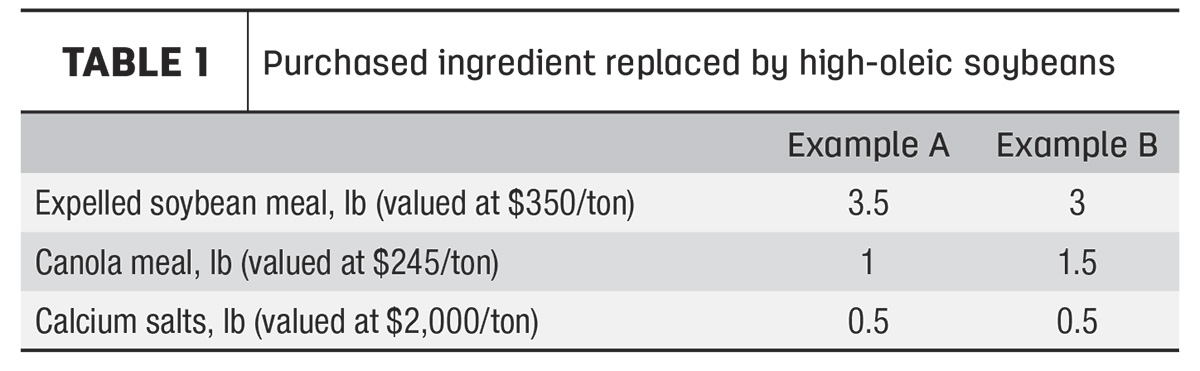
The diet changes resulted in a purchased feed costs savings of $1.24 per head per day in Example A and $1.21 per head per day in Example B.
Example A had a milk response of 6.8 pounds of energy-corrected milk (ECM), which was worth 95 cents per head per day. When we add in the feed cost savings, high-oleic soybeans increased revenue by $1.17 per head per day.
Example B had a milk response of 4.9 pounds of ECM, which was worth 63 cents per head per day. When we add in the feed cost savings, high-oleic soybeans increased revenue by 82 cents per head per day.
Growing and feeding high-oleic soybeans is a rapidly evolving opportunity for today’s dairy farms. As high-oleic soybeans gain more attention and adoption in the industry, consider how they may find a place on your farm. Currently, soybean growers may be able to capture a premium to grow high-oleic soybeans, and dairy producers may be able to reduce feed costs and increase ECM by incorporating them into their feeding program. If a dairy farm can manage the agronomic, marketing and processing factors necessary to effectively incorporate high-oleic soybeans in its system, high-oleic soybeans can make cents for the farm’s bottom line.