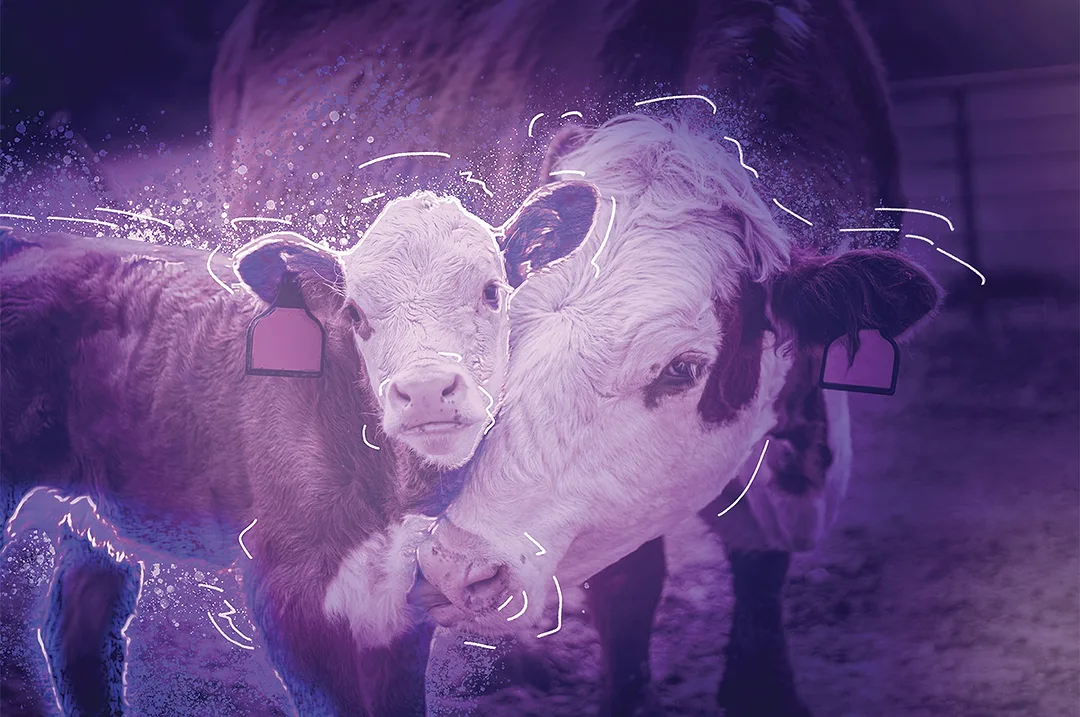
Emerging technologies in pheromone application are enhancing the stress management scene in cattle production. Traditionally, stress reduction has been recognized under the Beef Quality Assurance (BQA) umbrella of effective stockmanship. By reducing stress during handling events, improvements are seen in immune function, performance and reproductive efficiency, while negative meat quality outcomes like bruising and dark cutters are reduced. When coupled with low-stress cattle handling, pheromone application introduces a multidimensional approach to stress suppression that may offer additional tools to support BQA stress management principles.

Dr. Trey Patterson, a former chair of the National BQA Advisory group and president and CEO of Padlock Ranch Company in Ranchester, Wyoming, says BQA goals can be achieved through effective stress management.
“Managing stress in beef cattle is inherent to the Beef Quality Assurance Program,” Patterson says. “Cattle that are not under stress are more productive, healthy and produce better quality beef for the end consumer. This results in greater profitability for producers and our industry.”
Several analogue pheromone products are on the market that advertise their ability to reduce cattle’s threat perception in high-stress situations. These include during weaning, processing, transport and even potentially painful procedures like castration, dehorning and branding.
The mechanism at play is based on a naturally occurring pheromone found in all mammals, and specifically for cattle, maternal bovine-appeasing substance (mBAS). The pheromone is secreted by lactating animals via the skin adjacent to the mammary glands. Calves are inherently exposed to mBAS at their mother’s side, assisting with pair bonding and perceived security. FerAppease, CattleZen and Secure Cattle each incorporate a variation of the mBAS pheromone in their products to mimic the function of the pheromone in nature.
Britney Creamer is a regional sales manager for FerAppease. She says the product helps cattle respond better to stress, boosting both cattle well-being and performance.
“FerAppease helps cattle handle high-stress events by helping block stress signals from escalating to the brain,” she says. “Cattle don’t fully trigger that fight or flight response and stay more settled, keep eating and perform the way they are supposed to.”
When applied in a manner that can be perceived via smell (typically on the muzzle), mBAS products alter brain function in the amygdala and hypothalamus, resulting in reduced threat perception. Consequently, cattle exhibit behavioral changes to external stimuli that would typically elicit a stress response. Producers and product-supported studies have reported that cattle exposed to mBAS analogues settle more quickly, experience improved vaccine response, and record better gains and overall performance. Product claims even include improvements to handler safety.
Dan McCarty is president of Kolorado Land & Cattle, where he operates several ranches across Colorado’s Western Slope, including a feedyard. Between weaning calves and breeding heifers, Kolorado Land & Cattle has tested mBAS analogues via the FerAppease product and observed apparent changes in cattle behavior.
“We weaned three sets of calves with it last year,” McCarty says. “The second set of about 300 calves was the easiest weaning set of calves I’ve ever been around. After 48 hours in the feedlot (postweaning), there was zero vocalization, and all but three calves were at the bunk eating. I’ve never seen anything like it.”
In addition to reducing visible weaning stress, McCarty captured data indicating that treatments were down 10%-15% from previous years. Further, all calves weaned with mBAS products outperformed their backgrounding ration’s target average daily gain (ADG).
His experience with heifer A.I. was similar; however, he acknowledged the importance of timing the dose.
“We applied it when we pulled CIDRs [controlled internal drug releases], and they were certainly calm when we heat detected and bred them,” McCarty says. “They were actually pretty hard to get through the chute. Products reps recommended applying it when you actually breed to help them settle rather than when you pull CIDRs.”
Regardless, McCarty says his operation will continue to regularly incorporate FerAppease at weaning and likely during other stressful management procedures.
“Our feedyard manager swears by the stuff,” he says. “It certainly reduces stress on the animal, and we plan to use it for all weaning going forward. We are also experimenting with it when working bulls, hoping it takes the edge off when running large groups of bulls through the chute.”
Many of the benefits reported by McCarty and others are in clear support of the BQA curriculum, suggesting that mBAS pheromone analogues may align with BQA’s emphasis on stress reduction when used alongside established best management practices.
“From a BQA standpoint, reducing stress is everything,” Creamer says. “When cattle handle stress better, you support improved vaccine response, smoother handling and more consistent performance all the way through to the rail.”
BQA’s progressive approach to new and emerging topics promotes continuous improvement, and the program recognizes the potential for pheromone technology to positively influence cattle well-being and beef quality.
However, Patterson noted that BQA’s mission points to science-based production practices, and therefore the program encourages further research on pheromone application before incorporating it into its lineup.
“The reason that the practices recommended by BQA move the needle in such a big way is because they are based on science-based information, not emotion or trends,” Patterson says. “Using sound research combined with practical application leads to the continuous improvement needed in our cattle operations.”
Yet Creamer says mBAS products such as FerAppease aren’t just a trend, and her company’s millions of dollars in research investment are why FerAppease is gaining traction internationally.
“We didn’t just bring FerAppease to market and hoped it worked – we invested several million dollars to prove it. Today, we’ve got 15 published university trials, nine more finishing up and over 60 field studies with veterinary partners and large operations,” she says. “That’s helped us build enough confidence in the marketplace to move over 30 million doses in just three years.”
With further research and consideration by the National BQA Advisory group, the application of mBAS analogues could be the catalyst that enhances BQA’s stress management guidance. The concept of stress reduction in cattle supports a positive perception of beef production and cattle care.
As one of the few producer-facing, beef checkoff-funded programs, BQA serves as a conduit between beef cattle producers and beef consumers who are curious about how their food was raised and grown. By promoting stress management and other production standards that support cattle well-being and beef safety, the BQA program plays a substantial role in building beef demand.
Creamer believes in the data and says that utilizing mBAS pheromone analogues is a win-win for both producer profitability, consumer acceptance and ultimately beef demand.
“With the current [FerAppease] formulation, we’re consistently seeing reduced stress indicators like cortisol and measurable effects on inflammation,” Cramer says. “At this point, FerAppease stands among the most researched products in animal health today. It’s a tool that adds value for the producer while also supporting animal care practices that today’s consumer can feel confident about.”
For more information about the BQA program and its guidance pertaining to stress management, visit their website and download the National BQA Manual in the resources tab.