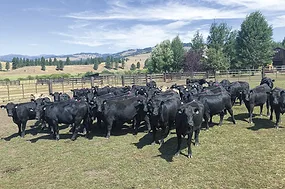
It is nearly the bull sale and bull buying season! Here in Lemhi County, Idaho, you can go to six bull sales in two weeks and not leave the county. Each ranch selling bulls has raised, fed and tested only their best for the sales. So how do you decide which bull to purchase?

Choosing the correct bull(s) for your operation is extremely important. The cows in your operation influence one calf per year, but a bull has the potential to influence up to 25 or more calves per year.
When choosing a bull to purchase, I suggest starting with your ranch goals and last year’s production records. Your ranch goals need to be SMART, written down and shared with everyone involved in the operation. SMART goals are specific, measurable, agreed upon, realistic and tangible. The goal needs to be specific and well defined as well as clear to anyone involved in the operation. If you can’t measure the goal, you have no way to determine if you achieve it. All stakeholders should agree with the goal. Is the goal realistic and within the availability of resources, knowledge and time? You need to check and make sure it is tangible within the time established. You want enough time to achieve the goal but not so much that it is not important.
Each goal also needs to have a cost attached to it. This gives you direction, focus and standard of measurement. It also helps in the budgeting process. As you review your production records, determine if you reached last year’s goals. If you didn’t, can you identify why? Are there management changes that need to be made? After you write up your goals for 2025, consider the following to help you determine the steps necessary to reach your objective.
- What do I need to reach this goal?
- Where am I now?
- What are the obstacles?
- What are the solutions?
Can the “right” bull help you achieve that goal in 2026? Let’s look at a couple of scenarios. If the ranch goal is to “increase average weaning weight by 5 pounds by sale date in 2027 at a cost of $5,000,” then you are going to look for a bull with genetics for growth. As you review the bull catalogs, pay attention to expected progeny differences (EPDs) and $value indexes related to growth. If the ranch goal is to improve the females of the herd, the goal may read like this: “Decrease calf death before weaning by 2% by reducing dystocia and increasing mothering ability at a cost of $5,000.” Here, you would look at EPDs and $value indexes related to maternal traits.
Now it is time to get out the pen, a cup of coffee, and the sale catalogs and look at the data provided. Circle the bulls that interest you and cross out the ones that do not, keeping in mind your ranch goal and traits needed to help you reach that goal. Once you have a pool of bulls that you are interested in, spend time comparing their EPDs so you can determine the differences between them. With this information, build a ranking sheet from your number one choice down to your last choice. You will want to have this information with you when you go to the bull sale.
A bull can have all the genetic potential in the world, but if he does not have the conformation, structural correctness and good feet and legs to get around on, he cannot help you reach your goal. As you look at each bull, examine him closely. Give him a score for visual appeal, conformation, structural correctness, and the visual traits you feel are important. That score can be 1 to 4, with 1 being low and 4 being high. You can also use scores 1 to 6 or 1 to 10. The key is to use an even number on the top end that prevents you from having a bunch of “middle” bulls. They either score above or below. Once you see the bulls, you may alter your ranking sheet.
Now for cautions. We all know that genetics can get messy, so we need to consider the ripple effects of our choices. In the first scenario, we were looking for increased growth. The ripple effect of increased weight at weaning can increase calf weight at birth, which could lead to increased dystocia. One of the traits you might select for in the second scenario is increased milk. The ripple effect here is that at maturity, that cow is going to need more and/or better feed to produce that milk and maintain body condition score to rebreed.
Utilizing your ranch goals to choose which bull to purchase at a bull sale this spring can also be used to select which A.I. sire you select semen from. Those A.I. sires have more data behind them to determine the EPDs and the $value indexes. What you do not have is the opportunity to consider the live animal. You must be satisfied with pictures of the bull. But rest assured, reputable A.I. companies are not going to collect a bull that is not structurally correct and has bad conformation. You may need to adjust the cost to achieve the goal as you review the price per straw and follow a synchronization protocol. You will also have to determine which cows to inseminate. If you are doing artificial insemination, that may affect which bull you purchase and the price you attach to the goal.
Having SMART ranch goals written, discussed and assigned a dollar amount should help with bull shopping. It will help you focus on those traits that will assist you in reaching your ranch goals and not purchasing a bull just because it was a good deal. Not all "good" deals will help you reach your goal.