The USDA National Agricultural Statistics Service released its semiannual Cattle report on Jan. 30. The total of all cattle and calves on Jan. 1, 2026, was estimated at 86.155 million head, a year-over-year decline of 316,900 head, or 0.4%. The decline across most cattle classes was only partially offset by increases in milk cows, beef heifers for replacement and bulls. Cattle inventories have now contracted for seven consecutive years, marking the 12th year of the current cattle cycle – the cyclical expansion and contraction of the national cattle herd over time. The cycle is influenced by the combined effects of cattle prices and input costs that drive cow-calf producer profitability, the gestation period for cattle, the time needed for raising calves to market weight and weather conditions.
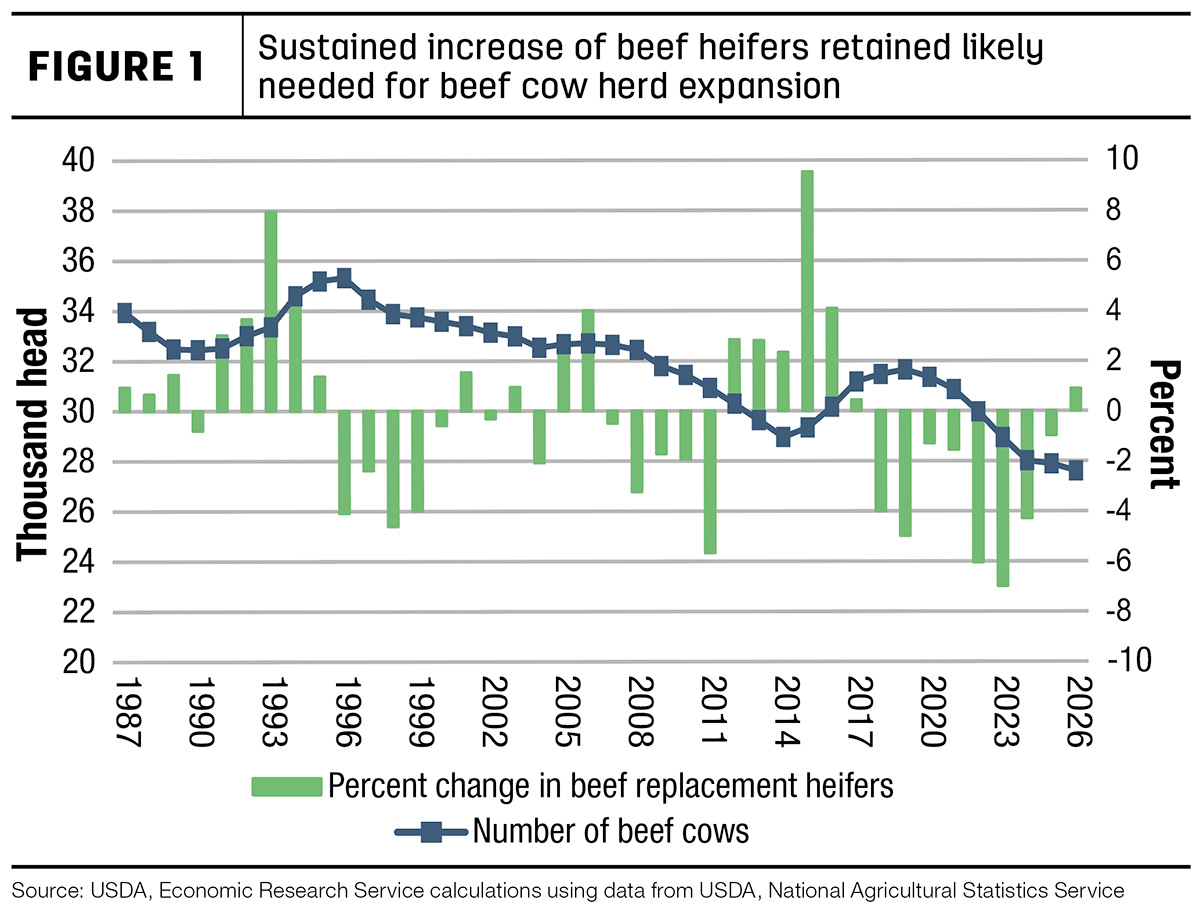
A closely watched leading indicator of the cattle herd is the number of beef cows and beef replacement heifers. Figure 1 shows the Jan. 1 estimate of beef cows and the percentage change in beef heifers retained over the past 40 years. This year, beef cows totaled 27.607 million head, down 1% from last year, which is 40% below the historic peak set in 1975 and remains the smallest inventory since 1961. With respect to beef replacement heifers, it is estimated that producers plan to retain 4.714 million, which is up nearly 1% from last year and the first year-over-year increase since 2017. Figure 1 would suggest that an increase in beef cow inventory is typically preceded by two to three years of sustained year-over-year growth in beef heifer numbers. This also correlates to the time it takes for heifer calves to physiologically mature and reproduce.
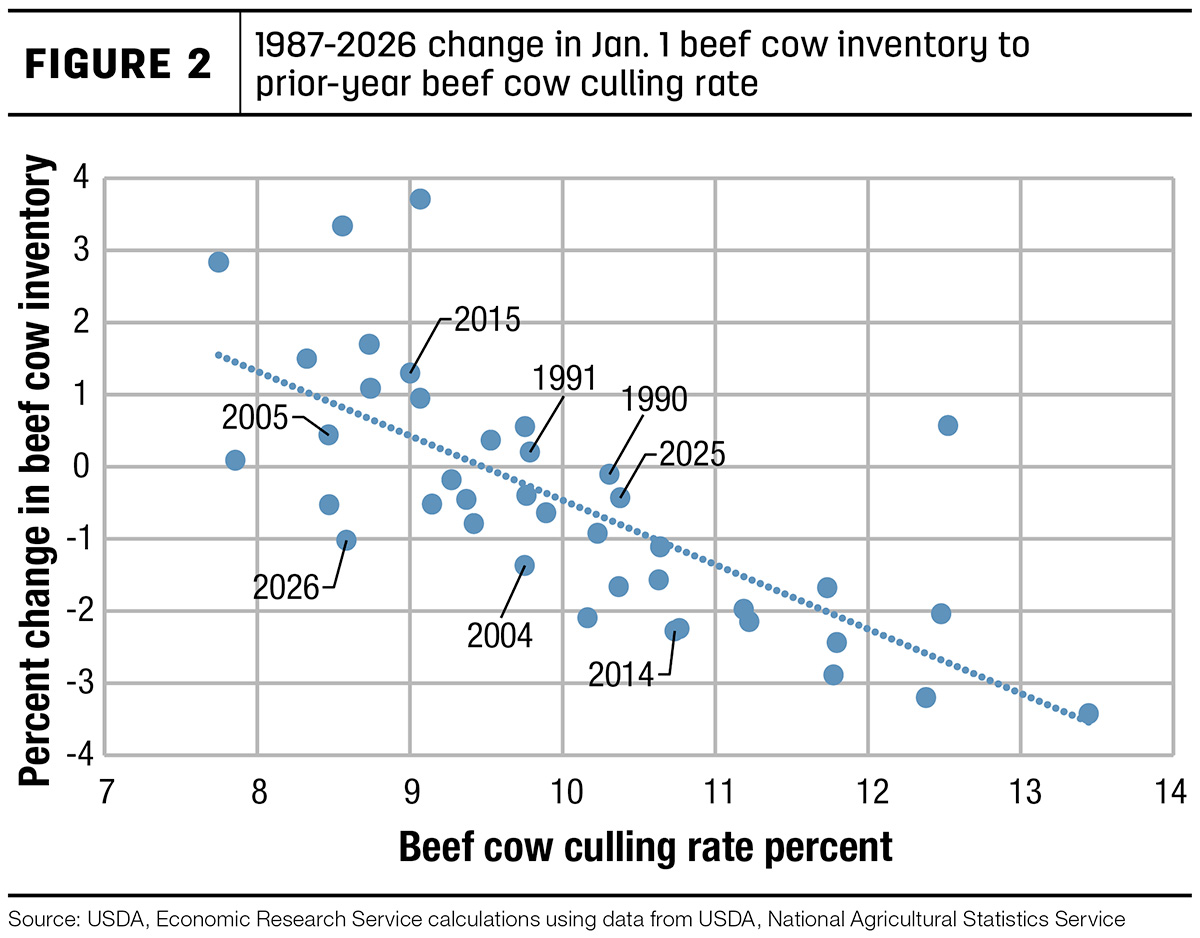
Another factor behind the change in beef cow inventory is the culling rate of beef cows in the prior year. Figure 2 plots the percent change in beef cows on Jan. 1 to the culling rate the prior year from 1987 to 2026. Based on the scatter plot, it would suggest that a year-over-year increase in beef cows may correlate to a culling rate of around 9% or less the prior year. However, the Jan. 1, 2026, beef cow inventory did not rise from last year despite a culling rate below 9% in 2025. That said, the pace of beef cow slaughter will be a metric to follow this year.
Feeder calf supplies remain tight
Focusing on cattle supplies for feedlots and beef production, according to the Cattle report, the inventory of steers 500 pounds and over were estimated at 15.601 million head, down 96,000 head from Jan. 1, 2025, and other heifers 500 pounds and over were estimated at 9.398 million head, down 144,200 head from last year. Further, the 2025 calf crop estimate was revised down from the July Cattle report to 32.896 million head, a drop of 520,900 head from the prior year.
Additionally, the Cattle report estimated the number of cattle on feed in feedlots of all sizes to be 13.848 million head, down 474,900 head from last year. To some extent, the relatively large decline in cattle on feed is likely reflected in the 200,000-head increase in cattle grazing small-grains pastures in the three-state area. Based on steers, other heifers and calves under 500 pounds available and subtracting the total number of cattle in feedlots, there was an increase of 218,600 calves available to place in feedlots early in 2026. The total, 24.498 million head, was the second-tightest supply for Jan. 1 since the series began in 1996.
Production outlook raised for 2026
The latest USDA NASS Cattle on Feed report estimated Jan. 1 cattle in feedlots of 1,000 head or greater to be 11.45 million head, about 3% below last year. Feedlot net placements in December were 5% lower year over year at 1.496 million head. Marketings in December were 1.773 million head, up almost 2% year over year. On Jan. 1, the number of cattle on feed over 150 days was up 90% above year-ago levels, largely due to the slower pace of marketings in the second half of 2025.
Slaughter data through January suggest the pace of federally inspected steer and heifer slaughter is 9.3% behind the same time last year. Part of the slower pace is likely due to adverse winter weather experienced toward the end of January. In February, the slower pace of slaughter appears to be a continuing theme. Given feedlot operations’ ability to maintain cattle on feed for longer durations, fewer fed cattle slaughtered in the first quarter are expected to be partially offset by higher marketings for slaughter in the second quarter.
In the second half of the year, fed cattle slaughter is expected to be higher than last month’s report, as many of the calves on small-grains pastures will move to feedlots in the first and second quarters. These changes are expected to support an increase in marketings for the second half of 2026. Further, the increase in fed cattle marketings in the slaughter mix raises the outlook for average carcass weights for the year.
Higher fed cattle marketings, heavier average carcass weights, as well as an increase in cow slaughter from last month, raise the projection for 2026 beef production by 185 million pounds to 25.92 billion pounds, 0.3% below last year.
Cattle prices raised on price strength
In January, the weighted average price for feeder steers weighing 750-800 pounds at the Oklahoma National Stockyards was $360.04 per hundredweight (cwt), a $15.50 increase from December and a new record for the month by almost $86. In the first sale of February, feeder steers averaged $364.51 per cwt, an increase of $6 from the last week of January and nearly $94 above the same week last year. Despite higher-than-expected supplies of cattle available for placement in 2026, based on the January Cattle report, supplies overall remain very tight. Based on current prices, the price outlook for feeder steers is raised $7.25 to $364.25 per cwt, an increase of 13% from 2025.
The January average price for slaughter steers in the 5-area marketing region was $234.58 per cwt, $8.32 higher than December and beating the record for the month set last year by more than $30. In the first week of February, prices averaged $241.31 per cwt, the highest weekly price since the first week of September 2025. However, slaughter cattle may face some short-term headwinds as wholesale boxed beef prices typically decline seasonally in February. This downtrend of boxed beef prices would come at a time when packer margins are relatively weak, and the slaughter pace is slower than expected given the percentage of cattle on feed over 180 days. Based on recent price data, the 2026 price forecast is adjusted $4.50 higher from last month, with the annual price projected at $240.25 per cwt, almost 7% higher than 2025.
Beef exports
Beef exports in November were 190 million pounds, about 25% lower than in 2024. The largest year-over-year reduction was in exports to China, down nearly 38 million pounds (96%), followed by exports to South Korea, down 13 million pounds or 22%. Shipments to all the top six markets were down year over year, but exports to Hong Kong were up 4.5 million pounds (55%), and exports to smaller markets outside of the top seven were up about 5%.
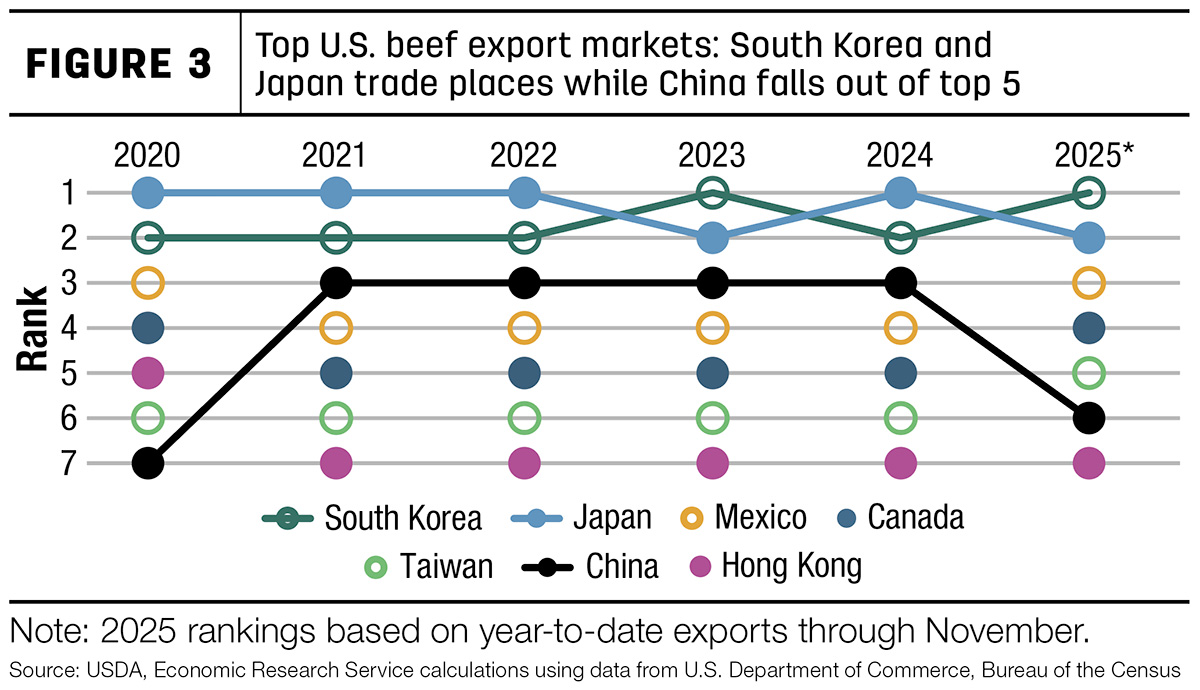
Figure 3 compares the ranking of the top seven markets for U.S. beef exports over the last six years, with 2025 rankings based on data through November. South Korea and Japan have been the top two markets for U.S. beef exports since 2016; the two markets have traded places as the top market for the last four years. In 2021, China rose to be the third-largest market for U.S. beef, and it held that ranking consistently for four years. However, exports to China fell off in April 2025 due to the nonrenewal of export registrations by the General Administration of Customs of China. As a result, China has fallen out of the top five markets for U.S. beef thus far in 2025.
The export forecasts for 2025 and 2026 are unchanged from last month. The 2025 estimate is 2.568 billion pounds, which would be a year-over-year decrease of nearly 15%. This would represent about 9.9% of production. The 2026 forecast is 2.425 billion pounds, which, if realized, would be a further 6% decline year over year and would account for about 9.4% of production.
Beef imports
Beef imports in November were slightly stronger than expected at 413 million pounds, up nearly 2% year over year. Imports from Australia climbed to 149 million pounds, 31% above a year ago. This was the largest monthly import volume from Australia since January 2003. Imports from Mexico were also elevated in November, up 45% year over year and the second-highest monthly import behind May 2020. Imports from Brazil were down 72% year over year, and imports from New Zealand were down 11%.
With the beginning of the new year, the opening of the 2026 tariff-rate quotas is expected to bring additional beef imports in the first quarter. The official trade statistics for January are not yet available; however, there are a few other sources that provide indications of how January beef imports compared to last year’s record levels. According to the USDA Agricultural Marketing Service weekly Imported Meat Passed for Entry report on Feb. 6, 2026, cumulative U.S. beef imports are 7% higher compared to the same period a year ago. Leading the way are increased imports from Argentina (up 118%), Nicaragua (up 40%), Uruguay (up 39%), Brazil (up 16%) and Australia (up 5%). Additionally, the weekly Commodity Status report from the U.S. Customs and Border Protection on Feb. 2, 2026, shows the quota for countries without a specific quota or free trade agreement was filled on Jan. 6 this year. Beef imports from the countries subject to this quota have subsequently faced an additional 26.4% tariff for the rest of the year.
On Feb. 6, a proclamation was issued to temporarily increase the U.S. tariff-rate quota for beef imports from Argentina. Previously, the quota for Argentina was set at 20,000 metric tons per year; the new proclamation permits an additional 80,000 metric tons of lean beef trimmings per year to be imported tariff free in four quarterly tranches of 20,000 metric tons each. Using the conversion factors from the USDA Economic Research Service Livestock and Meat International Trade data, 20,000 metric tons of lean beef trimmings on a product weight basis equate to just under 60 million pounds on a carcass weight equivalent basis. Over the whole year, the new quota would account for about 4% of total imports and less than 1% of total disappearance. Argentina’s exports to China will be limited in 2026 by China’s new safeguard import quota, potentially increasing available supplies to ship to the U.S. However, some of these increased duty-free imports to the U.S. from Argentina are expected to displace imports from other countries that are subject to an over-quota tariff.
Due to the strong pace of imports in November, the fourth-quarter 2025 estimate is raised 25 million pounds to 1.2 billion. The annual estimate for 2025 is 5.394 billion. Based on continued strong demand for lean processing beef and the increased import quota for Argentina, third- and fourth-quarter forecasts for 2026 are also raised 25 million pounds each, bringing the annual total to 5.575 billion pounds, which would be a year-over-year increase of 3.4%.