As it always is, the 2025 edition of the Beef Improvement Federation (BIF) Symposium – hosted June 9-12 in Amarillo, Texas, by West Texas A&M University – delivered boatloads of cutting-edge research results and practical applications of genetic tools. Beef genetic researchers, allied industry experts and seedstock and commercial producers from across North America gathered to exchange knowledge and methods of improving beef cattle production. Beef on dairy, sustainability initiatives and genomic testing were hot topics, but the event covered myriad other topics that can be applied on beef cattle operations.

Following are some of the highlights.
Beef’s precision ag
“Genomic testing is the precision agriculture for the cattle industry,” said Jamie Courter, assistant professor and state beef genetics extension specialist with the University of Missouri, as she presented on the economic viability of utilizing genomic tests on commercial cattle operations.
There are over 1 quintillion (that’s a 1 followed by 18 zeros) points of genetic combination in any single bovine. That means that, even between beef animals that are full siblings, there is a vast array of phenotypic possibilities. When pedigree-based expected progeny differences (EPDs) made their debut in the beef industry in 1983, it opened up all kinds of new doors for genetic improvement. Now, producers didn’t have to rely solely on what their eyes told them but on thousands – millions, even – of phenotypic data points from a potential herd sire or dam, as well as countless relatives of that animal. EPDs changed the game, and genetic improvement of beef animals accelerated at an unprecedented rate. The first bovine genome was sequenced in 2006, and the first genomically enhanced EPDs (GE-EPDs) became available in 2009, further enhancing both commercial and seedstock producers’ decision-making potential.
But even today, more than four decades after EPDs were introduced, that data is available almost exclusively on seedstock animals. Courter said it doesn’t have to be that way. She pointed to three primary reasons seedstock producers genomically test their bulls – to more accurately predict performance and EPDs, to pave a way for faster genetic turnover and to provide more accurate data on traits that take longer to measure in the field, such as stayability.
Courter believes genomic testing can provide a major boost to productivity and profitability on almost any beef cattle operation when employed correctly. At the current average price of around $30 a head, having a well-thought-out plan in place is key.
“It works, but it only works if you know what you’re going to do,” she said. “We have to make sure we’re not just doing the test, putting the results in a drawer and saying, ‘Yeah, that was a neat experiment.’”
While there are a lot of things that could be done with genomic data in a commercial herd, Courter pointed specifically to two: determining which of your potential replacement heifers are most worthy of retaining, and getting involved in genomically verified feeder cattle programs for your steers. And while genomic testing in commercial herds can be powerful, Courter said it’s not a basket to put all your eggs in.
“Commercial genetic testing is a tool,” she said. “But you have to figure out how to make it profitable for your operation. I would love to be able to say, ‘This is the return on investment of a commercial genomic test,’ but there are just as many ways you can make money on it as there are stars in the sky.”
Bigger is better … right?
The size of feeder cattle has steadily risen over the decades, but as the U.S. cow herd has shrunk over the past few years, cattle are being fed longer and to higher finishing weights than ever before to keep up with beef demand. It’s not uncommon these days to see a steer walk off the truck at the packing plant at 1,600 pounds. So how are our partners further down the supply chain – meat packers, retailers and food service – handling these bigger animals? How can we help them best utilize these bigger carcasses? And how big is too big?
Trent Schwartz, an assistant professor of animal and meat sciences at West Texas A&M University, answered some of these questions during a presentation at BIF. One question on the minds of those attending Schwartz’s session was how increased carcass size has affected meat quality. According to Schwartz, it hasn’t much.
“If the age [of the animal] is relatively the same, you’re not going to have big discrepancies in tenderness,” he said. “Tenderness in the U.S. is not an issue anymore. … We are so good at aging beef now. We are so good genetically. Twenty or 30 years ago, one in four steaks might be a bad eating experience. Now we’d be lucky to find one in 10 that said they had a tough steak. I don’t think that’s going to be an issue as you increase in size, unless we just get them so old that we start having issues with collagen cross-linking in those cattle.”
Schwartz said a major part of fully utilizing a beef carcass is understanding different markets. Schwartz pointed out a few tougher cuts that are difficult to sell in North America but are in high demand in many Asian markets. He also expressed a belief that the beef industry can continue to receive high prices by embracing what consumers want. The prime example of this, he said, was the tomahawk steak, which is simply a bone-in ribeye.
“Everybody and their dog who comes in the grocery store wants a tomahawk steak,” he said. “Why? … Because it looks cool; that’s why we make it. I will never tell a customer who walks into our store that I won’t make one of these. For one, the price goes up per pound. Two, now I’m selling bone for 20 bucks a pound. And three, if somebody wants to buy beef, and they’re going to support the beef industry and help improve the beef demand, and they want this cut, we’re going to cut it, even though we as a group [cattle producers] probably would not purchase that product.”
For the full proceedings of the 2025 BIF Symposium, visit the Beef Improvement Federation website.
Credit where it’s due
The BIF also handed out several awards during the proceedings to ranches and individuals who have made significant contributions to the genetic quality of beef cattle throughout the industry. The winners included:
Seedstock Producer of the Year: River Creek Farms, Manhattan, Kansas
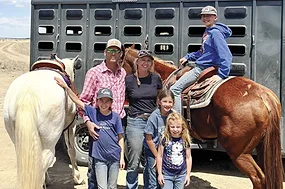
Commercial Producer of the Year: Price Ranch, Deer Trail, Colorado
Pioneer Award: David Steffen, University of Nebraska – Lincoln; Wade Shafer, International Genetic Solutions; Jeremy Taylor, University of Missouri; Jim Sanders, Texas A&M University; Joe Paschal, Texas A&M AgriLife; Steve Hammack, Texas A&M AgriLife
Continuing Service: Stacy Sanders, American Hereford Association; Megan Rolf, Kansas State University; Jessica Petersen, University of Nebraska – Lincoln; Tommy Perkins, West Texas A&M University; Clay Mathis, Texas A&M University; Daniela Lourenco, University of Georgia
Ambassador Award: Angie Denton, Kansas State University and Farm Journal